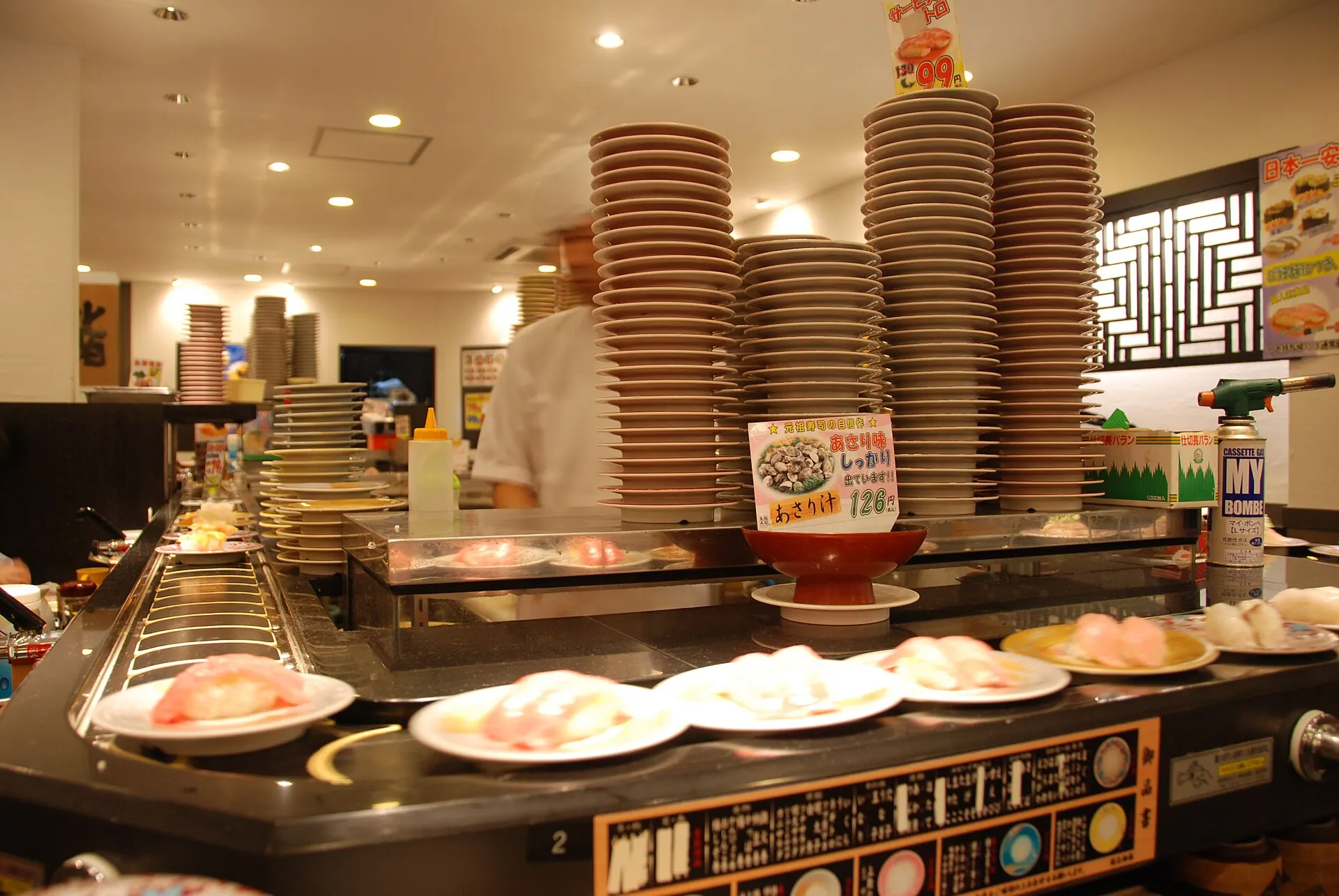
Kaitenzushi, conveyor-belt sushi, is where a lot of Japanese families eat on a Sunday night, and it is one of the best-value meals a traveler can have here. The national chains are cheap, fast and built around a tablet that speaks English. The regional chains in Hokkaido and Kanazawa are a different thing: plates that cost three or four times as much, fish from the local port that morning, and queues to match.
This guide covers both, with prices from the chains' own sites as of October 2026, and how to get in, order, pay and get out without holding up the person behind you.
How kaitenzushi works
You check in at a machine by the door, or in the chain's app before you arrive. The machine prints a ticket with a table number, or a queue number if the restaurant is full. At your seat you'll find:
- A touch panel. This is where almost all ordering happens now. Pick a language, tap a dish, and it arrives at your seat a few minutes later on an express lane, often a little tray shaped like a bullet train, that stops right in front of you. Take the plate and press the button to send the tray back. The slow belt still carries plates past at many chains, but most regulars order from the panel because it's fresher.
- Powdered green tea and a hot-water tap. The canister on the counter holds matcha-style powdered tea. Put a spoonful in a cup and push the cup against the tap in front of you. The water is scalding; keep your fingers clear.
- Gari, soy sauce and wasabi. The pickled ginger in the lidded box is free; take what you want with the tongs. Some chains leave the wasabi off and let you add your own; at Kappa Sushi, for one, every item comes without it, which is a relief if you're with children.
- Plates with prices. Plate color or pattern tells you the price band. You don't have to memorize the system, because the panel shows every price before you order.
When you're done, press the checkout button on the panel. Your plates get counted (at Kura, by the slot you've been posting them into), and you pay at the register or a self-pay machine near the exit.
 The express order lane above the slow belt. Photo: Syced, CC0, via Wikimedia Commons (resized).
Etiquette that actually matters
There isn't much, but these will spare you a glare:
- Never put a plate back on the belt once you've taken it, even if you change your mind.
- Don't take a plate from the express lane that isn't yours. It was ordered by someone at another seat.
- Stack your empty plates at the table (or post them into the slot at Kura). Staff count them, and so does the system.
- Use the gari tongs, not your chopsticks.
- Eat a piece in one bite if you can, and dip the fish side, not the rice, into soy sauce. Nobody will mind if you don't, but it keeps the rice from falling apart.
Explore Traditional Ryokans
Find your perfect traditional Japanese inn from our curated collection.
Browse All RyokansThe national chains
All prices below include tax, come from each chain's own menu or announcements in October 2026, and vary by branch. City-centre branches charge more than suburban ones at every chain.
Sushiro
The biggest chain and the one most travelers end up at. Its touch panels officially support English, simplified Chinese and Korean, and plates start at 120 yen. In July 2026 Sushiro raised a handful of staples, including its lean tuna, which now starts at 150 yen, while salmon, squid and shrimp stayed at 120 yen. Prices differ by branch, and Sushiro lists a separate menu for each one; its Dotonbori branch in Osaka starts at 160 yen a plate.
Book through the Sushiro smartphone app, which handles seat reservations and takeaway at every branch except Sakurazuka and the Sushiro To Go takeaway shops; Sushiro doesn't take table bookings by phone. When you arrive, enter your reservation number at the reception machine to check in. Sushiro takes credit cards and QR payments, but not Japanese electronic money such as Suica.
Order this: salmon. Sushiro singles it out as one of its most popular items, and it kept its 120-yen price through the July increase.
Kura Sushi
The one to choose if you're traveling with children, because of Bikkura Pon. There's a slot at every table; post five empty plates into it and a short game starts on the screen. Win and a capsule toy drops out of the machine above you. Kura introduced it in December 2000, and the prizes change with each character tie-in.
On 4 September 2026 Kura cut its cheapest plate from 115 to 110 yen and moved its branches onto four price bands: from 110, 115, 125 or 145 yen. The Global Flagship branch in Asakusa (Asakusa ROX, 4th floor) is in the 145-yen band and seats 272; you can book a table there through the Kura app or LINE.
Order this: the aged tuna (jukusei maguro), which Kura calls its signature item; it stayed at 120 yen.
Hama-sushi
The cheapest of the big chains on most plates. Salmon, shrimp, squid and dozens of other items are 110 yen at standard branches, and Hama's official menu runs its pricier fish at 132, 176, 231 and 319 yen. In central Tokyo, branches such as Akihabara, Ikebukuro and Ginza charge different prices, and Hama names its urban branches on the menu page. The website has English and Chinese versions, and the chain has its own app.
Order this: the 110-yen two-kind plates (nishu-mori), such as shrimp with tamago or two cuts of tuna, which let you try more for the same money.
Kappa Sushi
Kappa's draw for travelers is its all-you-can-eat. It runs 70 minutes, covers about 90 sushi, side and dessert items, and is booked in advance through Kappa's website or app. Kappa's October 2026 release puts it at 3,890 yen for adults at regular and urban branches and 4,190 yen at branches in station-front nightlife districts, running at every branch until 25 November 2026 for now. Leftover rice is charged at 33 yen a piece. Ordinary plates start at 110 yen, and Kappa publishes its regular menu in English.
Order this: the all-you-can-eat, on a weekday lunchtime, if you're hungry.
Uobei and Genki Sushi
Uobei, run by the same company as Genki Sushi, has no conveyor belt at all. Everything is ordered on the panel and comes straight to your seat on an express lane. More than 80 items are 110 yen, and the company says that price is the same at every Uobei and Genki Sushi in Japan; everything else costs more at its urban branches.
The Shibuya Dogenzaka branch near Shibuya Station is the one most visitors know, and it's one of Uobei's "super-urban" branches with higher prices on everything above 110 yen. Most Uobei branches let you join the queue online through the company's waiting-list site, but Shibuya Dogenzaka doesn't offer it, so expect to wait in person at peak times. The GENKI SUSHI × Uobei branch in Ueno does.
Order this: the big-cut tuna and salmon, which Uobei promotes as its signature cuts.
 Plate colors mark the price band. Photo: Tokumeigakarinoaoshima, CC BY-SA 4.0, via Wikimedia Commons (resized).
Premium regional chains worth a detour
These cost more, and they're worth it if you care about the fish. Expect a queue at every one of them.
Toriton (Hokkaido and Tokyo)
Toriton started in Kitami, near the Sea of Okhotsk, and is the conveyor-belt chain many Hokkaido locals send visitors to. Its official Hokkaido menu runs from 143 yen (tamago, natto rolls) through 253 yen for salmon to 594 yen for salmon roe and other premium plates. Most of its Sapporo branches are out in the residential wards rather than downtown, so a taxi is the easy way there. Sapporo's tourism site recommends the Hokkaido scallop.
In Tokyo there are three branches: Atre Shinagawa, Tobu Ikebukuro and Tokyo Skytree Town Solamachi. The Solamachi branch, on the 6th floor and five minutes' walk from Oshiage Station, takes no reservations, uses a ticket machine at the door and limits tables to 80 minutes. Tokyo prices run higher than Hokkaido's, up to 1,089 yen a plate plus market-price items.
Nemuro Hanamaru (Sapporo and Tokyo)
From Nemuro, the fishing port at Hokkaido's eastern tip. The most convenient branches are in JR Tower Stellar Place at Sapporo Station (6th floor) and KITTE Marunouchi by Tokyo Station (5th floor). The conveyor-belt shops take no reservations. You take a ticket at the machine, then scan its QR code to watch the queue on your phone and get called by LINE or email, so you can wander off. Arrive more than 15 minutes after your number is called and the ticket is cancelled. Get your ticket early and go shopping. The Stellar Place listing points to Hanasaki crab gunkan and salmon ara-jiru (fish-bone soup) among the specialties.
Mawashi Sushi Katsu (Katsumidori)
A Tokyo-area chain known for big cuts, whole-eel anago and around 200 items, with lean tuna from 154 yen and fatty tuna up to 715 yen on its grand menu. Note that the well-known Seibu Shibuya branch closed on 30 September 2026. The nearest now is in Atre Meguro at Meguro Station; others are in Gran Duo Kamata, Yokohama Sky Building and Chapeau Funabashi. Katsumidori publishes live wait times for each branch on its site.
Morimori Sushi (Kanazawa)
Kanazawa has some of the best kaitenzushi in Japan, and Morimori is the name most people know. Its Kanazawa Station branch is on the 6th floor of Kanazawa Forus, right by the east exit; the Omicho Market branch opens at 8:00 and closes at 16:30, which makes it a good sushi breakfast. Neither takes reservations. The three- and five-piece platters are the way to try Hokuriku fish without ordering a dozen plates; Kanazawa's tourism association singles out the Hokuriku five-piece, with gasu shrimp, whelk, firefly squid, nodoguro and white shrimp. Tabelog lists the Omicho branch as cash only.
When to go, and how to skip the line
- Avoid noon to 1pm and 6 to 8pm, especially on weekends and holidays. A Sushiro or Kura that's empty at 3pm can have a 60-minute wait at 7.
- Book or join the queue in the app before you leave the hotel at Sushiro and Kura, and book Kappa's all-you-can-eat ahead. At Sushiro you still check in at the machine when you arrive.
- At the premium chains, take a ticket first and explore after. Hanamaru's phone alert and Katsumidori's online wait times exist precisely so you don't stand in a corridor for an hour.
- Budget for 8 to 12 plates per adult. At a 110 to 150 yen chain that's roughly 1,200 to 2,000 yen, more if you order the pricier fish.
 The hot-water tap for powdered green tea. Photo: RuinDig/Yuki Uchida, CC BY 4.0, via Wikimedia Commons (resized).
Near your ryokan
Most ryokan stays include dinner and breakfast, so kaitenzushi is usually a lunch on the way in or out, or a meal in the city before you head to the hot springs.
- Kanazawa, before or after Kaga Onsen or Yuwaku. Kaga Onsen station is on the Hokuriku Shinkansen line from Kanazawa, so a Morimori lunch at Kanazawa Station or Omicho fits neatly before the train. Kanazawa also has inns of its own; see our Kanazawa ryokan guide, the best ryokans in Kanazawa and the rest of Ishikawa.
- Sapporo, before Jozankei or Noboribetsu. Jozankei Onsen is inside Sapporo city, in Minami ward, so a Hanamaru lunch at Sapporo Station fits before the bus out. For inns, see the best ryokans in Hokkaido, our Sapporo and Hokkaido guide and the Hokkaido region page.
- Tokyo, before a weekend out of the city. Toriton at Solamachi or Hanamaru at KITTE by Tokyo Station make a good last meal before a train to Hakone, Nikko or Izu. See ryokans near Tokyo and our weekend ryokan guide.
If what you want is a long seafood dinner, a ryokan with a kaiseki dinner included will give you more of it than any belt. Our kaiseki guide explains what you'll be served.
Sources
Checked October 2026.
- Sushiro: FAQ (app reservations, check-in); English site (touch-panel languages, payment, app reservations, prices from 120 yen); price revision of 22 July 2026; Dotonbori branch menu.
- Kura Sushi: price revision from 4 September 2026; Bikkura Pon 25th anniversary release; Global Flagship Asakusa ROX branch.
- Hama-sushi: official menu.
- Kappa Sushi: all-you-can-eat release, 21 October 2026; English menu.
- Uobei: 110-yen items; Tokyo branch list; news.
- Toriton: Hokkaido menu; Tokyo menu; Solamachi branch; Sapporo tourism listing.
- Nemuro Hanamaru: KITTE Marunouchi branch; FAQ; Stellar Place listing.
- Katsumidori: grand menu; Seibu Shibuya closure; wait times; Seibu listing (whole-eel anago).
- Morimori Sushi: Kanazawa Forus listing; Kanazawa tourism association on Omicho; Tabelog, Omicho branch.
Photo credits
- Cover: "Konveyer belt sushi at Asakusa" by Maarten Heerlien, CC BY 2.0, via Wikimedia Commons. Resized and cropped.
- Express lane by Syced, CC0, via Wikimedia Commons. Resized.
- Sushiro plates by Tokumeigakarinoaoshima, CC BY-SA 4.0, via Wikimedia Commons. Resized.
- Hot-water tap by RuinDig/Yuki Uchida, CC BY 4.0, via Wikimedia Commons. Resized.


Free ryokan planning guide
Japan travel tips, etiquette essentials, and our top picks — straight to your inbox.
Explore Top Ryokans
Discover highly rated traditional Japanese inns
Ready to book your ryokan?
Check dates, rooms and current rates for ryokans across Japan.
Planning a ryokan stay?
Get our free Japan ryokan planning guide — packing tips, etiquette, and our top picks by region.
No spam. Unsubscribe anytime.
Related guides
- Costco in Japan: what travelers should knowYour home membership works, but your Visa doesn't. A practical look at Costco Japan for visitors: fees, payment rules, all 37 warehouses and the ones you can reach without a car, the 180-yen hot dog, shipping, and whether it's worth the trip.
- A guide to the Japanese konbiniWhat to eat at 7-Eleven, FamilyMart and Lawson, how to pay, which ATMs take your card, the bag fee and the heating question, shipping a suitcase, tax-free after 1 November 2026, and how to use a konbini around a ryokan stay.
- Matcha in Japan: where to drink it and what to bring homeWhere to drink matcha in Uji, Kyoto, Tokyo and Kanazawa, from the old Uji tea houses to a municipal tea room facing the Byodo-in. Usucha and koicha explained, what to do at a tea ceremony, the sweets that come with it, and how to buy and keep tea to take home.
Ryokan Finder Editorial
We research and organize traditional Japanese inns across the country. About Ryokan Finder