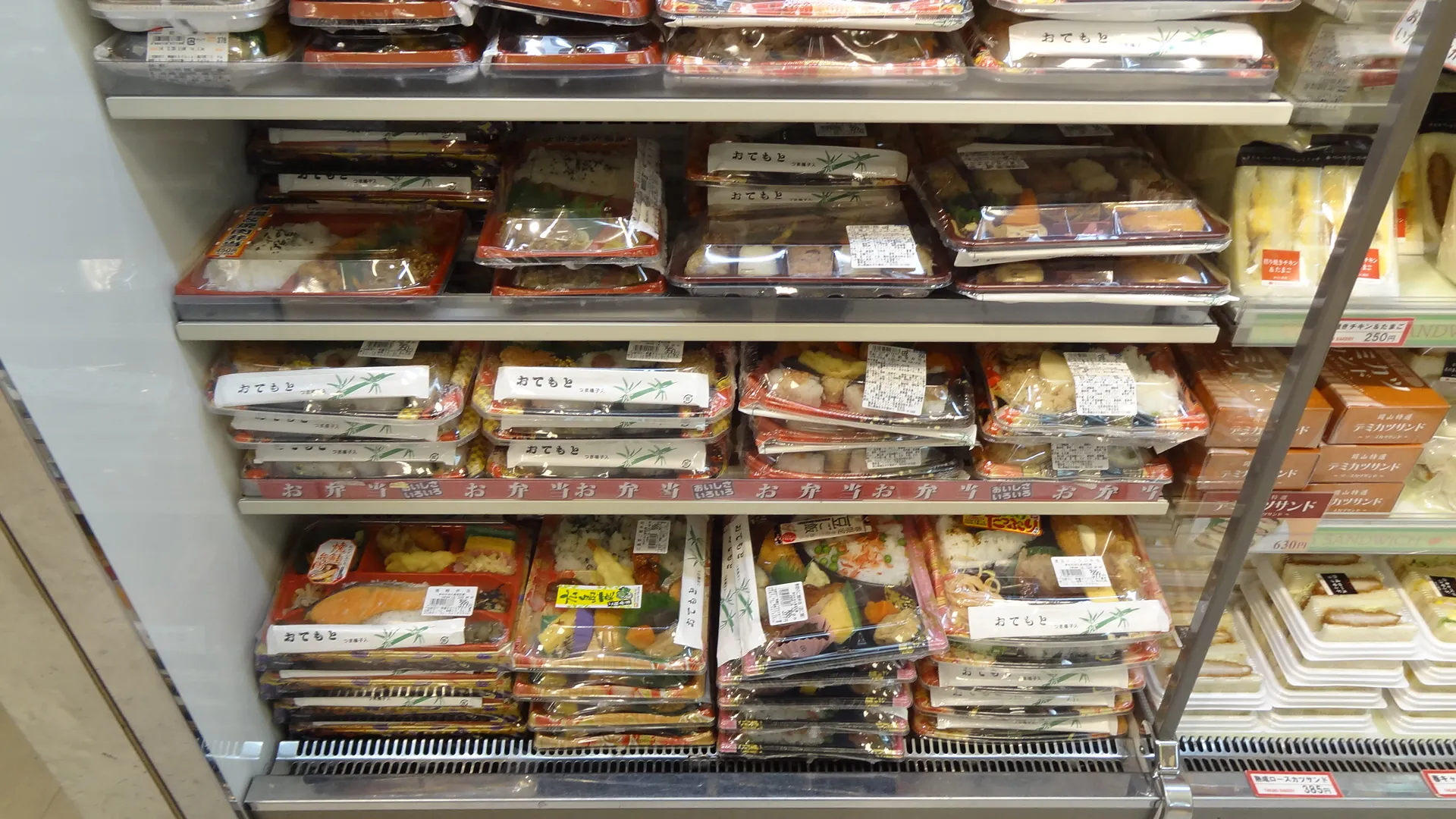
A konbini (コンビニ), the Japanese convenience store, is a different animal from the gas-station shop you might know at home. It is where office workers buy lunch, where people pay their electricity bills, and where you'll take out yen, print a train itinerary, buy a bus ticket and send a suitcase ahead to your ryokan. The food is good enough that plenty of visitors plan a meal around it.
This guide covers the three national chains, 7-Eleven, FamilyMart and Lawson. It explains what to buy, how the till works, and which services are worth knowing about, with the rules and fees checked against each company's own site in October 2026. The last section is about using a konbini around a ryokan stay, especially in onsen towns where the shops close early.
The big three
The three chains sell much the same range, and the differences come down to a few signature items.
- 7-Eleven (セブン-イレブン) opened its first Japanese store in Toyosu, Tokyo, in May 1974, which the company counts as the start of the country's convenience-store story. Its own bestseller list for visitors leads with the tuna-mayonnaise onigiri, the egg salad sandwich and Nanachiki, a thick fried chicken seasoned with 11 spices. Its ATMs belong to Seven Bank, the most foreigner-friendly network in the country (more on that below).
- FamilyMart (ファミリーマート), "Famima" to locals, is best known for Famichiki, boneless fried chicken you order at the register. Its visitor page also recommends its egg sandwiches, seasoned soft-boiled eggs and a SPAM onigiri. FamilyMart puts out new products every week and lists them on its site.
- Lawson (ローソン) is the one with the blue sign. Its signature is Karaage-kun, a box of five bite-sized fried chicken pieces, first sold in 1986 and now in a rotation of limited-time flavours (not at Natural Lawson branches). Its visitor page also steers you to the desserts, starting with the Premium Roll Cake.
You'll also see smaller chains, such as Ministop, Daily Yamazaki, NewDays in JR East stations, Poplar and Seicomart in Hokkaido. They work the same way, but their services differ from the big three, so the details below don't always apply.
What to eat
Onigiri, and how to open one
Onigiri, triangular rice balls wrapped in nori, are the konbini staple. Common fillings include salmon (shake), tuna mayonnaise (tsuna mayo), salted plum (umeboshi), cod roe (mentaiko or tarako) and kelp (konbu). The label is usually Japanese only, but the colour and picture on the band help.
The wrapper keeps the nori apart from the rice so it stays crisp, which is why it has a three-step opening. 7-Eleven's first wrap-it-yourself onigiri film dates from 1978.
- Pull tab 1 at the top straight down, all the way around to the back. This splits the film into two halves.
- Pull the right-hand corner (2) out sideways.
- Pull the left-hand corner (3) out the same way. The nori stays wrapped around the rice.
Pull gently and straight. If you twist, the nori tears and stays behind in the plastic. Onigiri without nori (seasoned or mixed rice) open the same way at the top; leave one side of the film on to hold it without getting rice on your fingers.
 One onigiri unwrapped with its nori intact, one still in the film. Photo: Amagase, CC BY-SA 2.5, via Wikimedia Commons (resized).
Sandwiches, bento and the rest of the chiller
The egg sandwich (tamago sando) is the one visitors rave about: soft white bread and a rich egg salad, at all three chains. Beyond it you'll find bento boxes, noodles hot and cold, salads, pasta, gratin, and a chilled-dessert section that's worth a look every visit. Bento and pasta are made to be heated (see "The heating question" below).
The hot counter
By the register there's a glass case of hot snacks: Famichiki at FamilyMart, Karaage-kun at Lawson, Nanachiki at 7-Eleven, plus croquettes, hash browns, yakitori and American dogs (corn dogs). You don't serve yourself. Point, or say the name, and the staff pack it for you.
Two more cold-weather favourites sit near the till at many stores:
- Oden, a dashi-simmered pot of daikon, eggs, fish cakes and konnyaku. 7-Eleven, which started selling it at the register in 1979, has a how-to video on its visitor site.
- Chukaman, steamed buns in a heated case, such as nikuman (pork) and anman (sweet red bean).
 FamilyMart's hot snack case, with Famichiki on the top shelf. Photo: 毒島みるく, CC0, via Wikimedia Commons (cropped and resized).
Drinks
Konbini have a heated cabinet for hot drinks in bottles and cans, a habit that surprises visitors: green tea, milk tea and coffee, warm to the touch. For fresh coffee, 7-Eleven and FamilyMart have self-serve machines: buy the cup at the register, then make the drink yourself (both chains have how-to guides for visitors). Lawson brews its MACHI café coffee in store.
Alcohol
Most stores sell beer, chu-hi (canned shochu highballs), sake, wine and whisky. At the register you'll be asked to tap an age-confirmation button on the screen. Drinking under 20 is illegal in Japan, and 7-Eleven notes that availability varies by store.
Explore Traditional Ryokans
Find your perfect traditional Japanese inn from our curated collection.
Browse All RyokansHow the till works
The cash tray
When you pay cash, put it in the small tray on the counter rather than handing it over. The staff count it, and your change and receipt come back on the same tray or into your hand. The register screen shows the total, and at many stores a self-service screen asks you to pick your payment method (7-Eleven's guide to its registers walks through it for cash, card and IC payments).
The heating question: "atatamemasu ka?"
If you buy a bento, pasta or anything else meant to be eaten warm, the staff will ask "Atatamemasu ka?" ("Shall I heat it?"). Answer "Hai, onegaishimasu" (yes, please) or "Daijōbu desu" (no thanks). 7-Eleven says most of its stores have microwaves and that some items can't be heated, so if you're not asked and want it warm, say "Atatamete kudasai." You may also be asked whether hot and cold items can share a bag.
The bag charge
Since 1 July 2020, every retailer in Japan has had to charge for single-use plastic shopping bags with handles. The Ministry of Economy, Trade and Industry left the price to each shop, as long as it's at least 1 yen a bag. 7-Eleven says bags are available on request and the fee depends on the size. Ask with "Fukuro onegaishimasu" (7-Eleven's own phrasebook gives "Kaimono bukuro o onegai shimasu"), or carry a foldable bag. The rule doesn't cover paper bags, cloth bags or bags without handles.
Chopsticks, spoons and wet towels
Cutlery isn't automatic. Staff will usually ask whether you need chopsticks (ohashi) or a spoon (supūn), and 7-Eleven says to ask for any you need when you pay. If you're taking a bento back to your room, this is the moment to say yes.
Eating it: where, and where not
Eating while you walk along the street is frowned on in Japan. Eat at the store's eat-in counter if it has one, or outside by the door. 7-Eleven asks eat-in customers to avoid long stays and loud conversation. It also notes a tax difference: takeaway food is taxed at Japan's reduced rate, but if you eat it in the eat-in area, the standard 10% rate applies.
Trash
Street bins can be hard to find in Japan, so the konbini bins by the door are tempting. They're there for rubbish from what you bought at that store. Sort by the labels (cans, PET bottles, burnables). Otherwise carry it back to your room. 7-Eleven asks eat-in customers to dispose of rubbish according to store rules.
Paying
All three chains take the major credit cards and contactless payment:
- 7-Eleven accepts Visa, Mastercard, JCB, American Express, Diners Club, Discover and UnionPay, plus Apple Pay and Google Pay. It takes cash in yen only.
- Lawson takes Visa, Mastercard, JCB, Amex, Diners Club, UnionPay and Discover. No signature or PIN is needed under 10,000 yen.
- FamilyMart lists JCB, Visa, Mastercard, Amex, Diners Club, Discover and UnionPay, and takes tap-to-pay cards.
IC cards (Suica, ICOCA and the rest)
The same transport card you tap through the ticket gates works at the till. 7-Eleven lists Kitaca, Suica, PASMO, TOICA, manaca, ICOCA, SUGOCA, nimoca and Hayakaken, including cards on Apple Pay or Google Pay, and Lawson and FamilyMart take them too. It's the quickest way to pay at the till.
ATMs that take foreign cards
This is the service that matters most for many visitors, because cash is still handy in Japan, especially in small inns and rural onsen towns.
| ATM | Where | Overseas cards accepted |
|---|---|---|
| Seven Bank | 7-Eleven, airports, stations, and Famima ATMs in FamilyMart | Visa, Plus, Mastercard, Maestro, Cirrus, UnionPay, American Express, JCB, Discover, Diners Club |
| Lawson Bank | Lawson | Visa, Plus, Mastercard, Maestro, Cirrus, JCB, UnionPay |
| E-net | FamilyMart | Visa, Plus, Mastercard, Maestro, Cirrus, JCB, UnionPay |
| Japan Post Bank | some FamilyMart stores | Visa, Plus, Mastercard, Maestro, Cirrus, JCB, UnionPay, Discover |
Every bank adds the same warning: some cards with these logos still won't work.
Seven Bank is the safest bet, and the only konbini network on this list that takes American Express. It has machines in 7-Eleven stores across Japan, plus international airports including Narita, Haneda, Kansai, New Chitose, Chubu, Fukuoka and Naha. Visa and Mastercard work around the clock. UnionPay, Amex, JCB, Discover and Diners Club cards have short overnight breaks, for example 23:50 to 00:10 for JCB. A single withdrawal on an overseas card is capped at 100,000 yen (30,000 yen on a magnetic-stripe card), and the bank says fees vary by card brand. The screens offer a choice of languages.
FamilyMart is mid-change. Since June 2026 it has been installing Famima ATMs, run by Seven Bank with the same functions as its other machines, Japan Post Bank says its roughly 5,400 machines in FamilyMart stores will close in stages over about three years from January 2027. For now you may find any of the three, and each is labelled.
Lawson Bank screens come in English, Simplified Chinese and Korean. Note one catch that applies to every konbini ATM: if the store isn't open 24 hours, the ATM shuts when the store does.
 Seven Bank ATMs, the network in every 7-Eleven. Photo: Rebirth10, CC BY-SA 4.0, via Wikimedia Commons (cropped and resized).
Some 7-Eleven and FamilyMart branches also have currency-exchange machines that turn foreign banknotes into yen. 7-Eleven says no ID is needed and that coins aren't accepted. FamilyMart's handle 14 currencies, including the US, Canadian and Australian dollar, the euro and the pound. Both chains have them at a limited number of stores, which their sites list.
Other services worth knowing
Printing and copying
Every konbini has a multifunction copier, and you can print straight from your phone, which is useful for a booking confirmation a ryokan wants on paper or a rail itinerary.
- 7-Eleven uses Fujifilm machines. The free 7-Eleven Multicopy app sends photos and PDFs to the machine over its own Wi-Fi and needs no registration. It works in English. Printing from the app costs 20 yen a page in black and white and 50 yen in colour (A4). The netprint apps upload a file and give you a reservation number valid for a day (no sign-up) or 30 days (with an account).
- FamilyMart and Lawson, along with Ministop and Poplar, use Sharp's Network Print service. Upload a file without registering and it is kept for eight days; members can keep files for up to 30.
Tickets
The same machines sell tickets. FamilyMart's copiers sell tickets for theme parks, aquariums, zoos and expressway buses, with screens in 11 languages and a support line in English and Chinese from 9:00 to 18:00. Lawson's Loppi terminal handles ticket bookings and other purchases, and 7-Eleven sells tickets through its copiers too. Not every menu is in English, so ask the staff if you get stuck.
Shipping luggage (takkyubin)
Takkyubin (宅急便), door-to-door parcel delivery, is how many visitors travel light: send your big case from Tokyo to your last ryokan and carry only an overnight bag in between.
- 7-Eleven and FamilyMart take Yamato Transport's TA-Q-BIN. Fill in a waybill at the counter, and the staff take the parcel and payment. Yamato says konbini can't send Cool TA-Q-BIN or International TA-Q-BIN, and that some can't take parcels over size 180 (length plus width plus height in centimetres). FamilyMart's own limit is size 160 and 25 kg, and some branches, such as those inside stations, don't take parcels.
- Lawson takes Japan Post's Yu-Pack instead.
7-Eleven says you can send to airports and hotels but should allow at least a day, more depending on distance. You can't send a parcel to a 7-Eleven to collect it there. If you're shipping to a ryokan, tell the inn first and put your name and check-in date on the label. Our ryokan check-in guide covers what to expect when you arrive.
Some 7-Eleven stores also act as luggage-storage points for the ecbo cloak service.
Wi-Fi
Don't plan around konbini Wi-Fi. 7-Eleven's free 7SPOT network closed on 31 March 2022, and FamilyMart's Famima_Wi-Fi closed in August 2022; FamilyMart now points customers to NTT Docomo's d Wi-Fi. Lawson is the exception. LAWSON Free Wi-Fi gives you 60 minutes a session, five sessions a day, after a one-time email sign-up, and it's meant for use inside the store.
Toilets
Many konbini let customers use their toilet, but not all. All three chains have said that for franchise stores, it's up to each owner. Some can't offer one because the toilet is behind the stockroom, for security reasons. Ask first ("Toire o karite mo ii desu ka?"), and buying something on the way out is good manners.
Tax-free shopping: it changes on 1 November 2026
Some konbini, mostly in big-city centres, airports and tourist areas, are registered tax-free shops. 7-Eleven says some of its stores offer it, and Lawson publishes a list of its own. But the national system changes on 1 November 2026, and the change makes tax-free konbini shopping even less likely to matter for snacks.
According to the Japan Tourism Agency, from that date:
- You pay the full, tax-inclusive price at a tax-free shop and show your passport.
- The tax is refunded after a customs check when you leave Japan. At the airport or seaport, before you check your bags, you scan your passport at a tax-free kiosk within 90 days of purchase.
- Purchases must total 5,000 yen or more before tax, per store, per day.
- Food, drinks and cosmetics consumed in Japan don't qualify. If you've eaten or used them, tell the customs officer rather than completing the procedure.
So the onigiri, beer and sweets you eat at the ryokan were never going to come back to you as tax. Gifts and cosmetics you take home might, if you buy enough at a tax-free branch.
Hours
Lawson describes itself as a chain that's open 24 hours, seven days a week, and most stores in all three chains are. But not every branch is. Lawson's own list of tax-free branches includes stores in hotels, airports and tourist sites that open 7:00 to 23:00 or 9:00 to 20:00, and if the store closes, so does its ATM. In the countryside and in small onsen towns, the nearest konbini may be a drive away or close in the evening. Check the hours on the chain's store finder or Google Maps before you count on one.
Using a konbini around a ryokan stay
A ryokan stay usually includes dinner and breakfast, and the meal times are fixed. Our ryokan dinner guide and kaiseki guide explain what you'll be served. A konbini fills the gaps around those meals.
- Don't snack your way through the afternoon. A kaiseki dinner runs to ten or more small courses. If you're arriving hungry, an onigiri at the station is plenty. Save the fried chicken for another day.
- Booked a room-only plan? Budget inns and room-only (sudomari) plans leave breakfast up to you. Buy it the evening before, because a rural konbini may be a long walk away and the shelves restock in the morning in the city, not always in the mountains. An egg sandwich, a yogurt and a bottled milk tea keep fine in the room fridge. If you'd rather be fed, our list of ryokans with meals included is the place to start, and the ryokan breakfast guide explains what a full Japanese breakfast involves.
- Onsen towns with few shops. Many hot-spring villages are built around inns, footbaths and a handful of souvenir shops, and the shops shut early. Do your konbini run at the last big station before the local bus or ryokan shuttle: water, snacks for the evening, any medicine you need, and cash. Small inns and village shops don't always take cards. Remote villages such as Kurokawa Onsen and the places in our hidden onsen towns guide are lovely precisely because they're quiet, so plan ahead.
- Water before the bath, beer after. Keep a bottle of water or tea from the konbini in the room for before and after a soak, and leave alcohol until you've finished bathing; our onsen etiquette guide explains why.
- Keep konbini food to your room. Don't bring it into the ryokan's dining room, and check the inn's house rules on outside food and drink, or ask at check-in. Our ryokan etiquette guide covers the rest.
- Ship your case ahead. Send your big bag by takkyubin from a 7-Eleven or FamilyMart and arrive at the ryokan with a day pack (see above, and our packing list for what to keep with you).
If you're eating out in a city before or after your stay, our guides to conveyor-belt sushi chains and Costco Japan cover two more everyday-Japan food stops.
Sources
Checked October 2026.
- 7-Eleven: visitor guide (bestsellers, bags, alcohol, heating, cutlery, eat-in, parcels); visitor FAQ (bags, tax-free, currency exchange, phrases); in-store payment (cards, IC cards, yen-only cash); printing (apps, prices); 50th anniversary archive (first store, 1978 onigiri film, oden from 1979).
- FamilyMart: visitor guide (Famichiki, ATMs, cards, currency exchange, multi-copy tickets); ATMs (Famima ATM from June 2026); parcels (Yamato, size 160 and 25 kg); payment methods; Wi-Fi (Famima_Wi-Fi closed August 2022).
- Lawson: visitor guide (Karaage-kun, cards, IC cards, ATMs, tax-free stores and hours, Loppi); Wi-Fi.
- Seven Bank: overseas cards and service hours; international ATMs (airports); Famima ATM.
- Lawson Bank: international ATMs.
- Japan Post Bank: closure of ATMs in FamilyMart stores from January 2027 (Japanese); Nikkei on FamilyMart's contract with Seven Bank (Japanese).
- Yamato Transport: sending TA-Q-BIN from 7-Eleven or FamilyMart.
- Sharp: Network Print.
- Ministry of Economy, Trade and Industry: plastic shopping bag charge from 1 July 2020 (Japanese).
- Japan Tourism Agency: tax-free refund method for travelers.
- Impress Watch: 7SPOT closing 31 March 2022 (Japanese).
- Business Insider Japan: 7-Eleven, FamilyMart and Lawson on toilet use (Japanese).
Photo credits
- Cover: "Bento Boxes in Japanese Convenience Store" by Martin Lewison, CC BY-SA 2.0, via Wikimedia Commons. Resized.
- Onigiri by Amagase, CC BY-SA 2.5, via Wikimedia Commons. Resized.
- FamilyMart hot snack case by 毒島みるく, CC0, via Wikimedia Commons. Cropped and resized.
- Seven Bank ATMs by Rebirth10, CC BY-SA 4.0, via Wikimedia Commons. Cropped and resized.


Free ryokan planning guide
Japan travel tips, etiquette essentials, and our top picks — straight to your inbox.
Explore Top Ryokans
Discover highly rated traditional Japanese inns
Ready to book your ryokan?
Check dates, rooms and current rates for ryokans across Japan.
Planning a ryokan stay?
Get our free Japan ryokan planning guide — packing tips, etiquette, and our top picks by region.
No spam. Unsubscribe anytime.
Related guides
- Costco in Japan: what travelers should knowYour home membership works, but your Visa doesn't. A practical look at Costco Japan for visitors: fees, payment rules, all 37 warehouses and the ones you can reach without a car, the 180-yen hot dog, shipping, and whether it's worth the trip.
- How to ride the shinkansen: tickets, seats, luggage and mannersA practical guide to Japan's bullet trains: the lines and train names, how to buy tickets online, at a machine or a counter, reserved and non-reserved seats, Green Car, Gran Class and the new Supreme Class, the oversized-baggage rule, which seat faces Mount Fuji, on-board manners and sending your suitcase ahead.
- Ekiben and Japan's big stations: what to eat on the train and how to find your wayThe station bento worth seeking out, from Mori's squid stuffed with rice to the Toge no Kamameshi pot and Toyama's trout sushi, where to buy them at Tokyo, Shinjuku, Sendai and Toyama, train-eating etiquette, and how to survive the big stations: food halls, coin lockers, IC cards, exits and signs.
Ryokan Finder Editorial
We research and organize traditional Japanese inns across the country. About Ryokan Finder