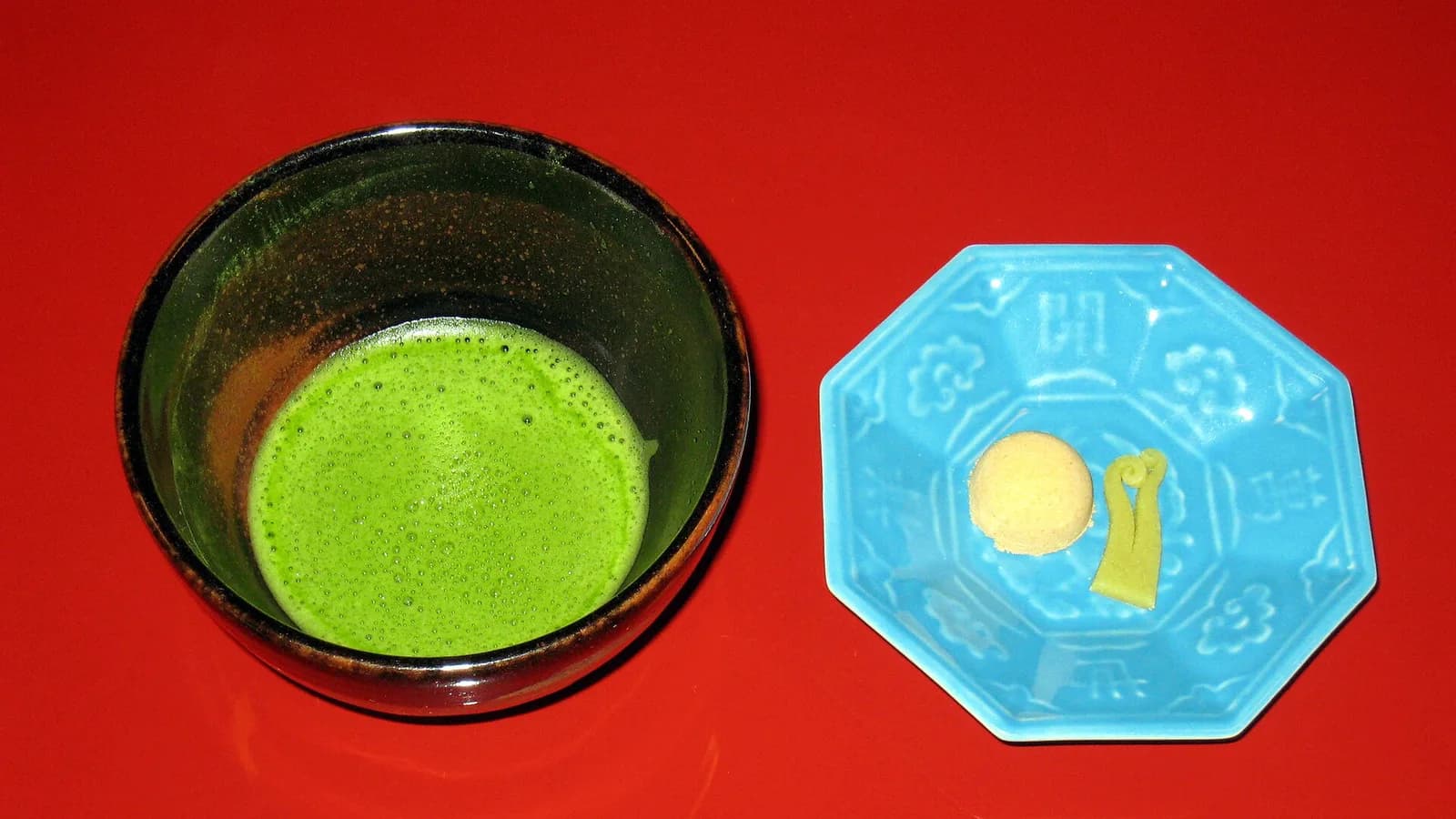
Matcha is powdered green tea, whisked with hot water rather than steeped, and you drink the whole leaf. Outside Japan it usually turns up as a latte. In Japan you can still drink it the old way, in a bowl, with a small sweet, in rooms that have been serving it for a century or more.
This guide covers where to do that in the places most visitors go: Uji, the tea town south of Kyoto; Kyoto itself; Tokyo; and Kanazawa, where tea was part of the Maeda lords' court. It explains usucha and koicha, what happens at a tea ceremony, the sweets that come with the tea and how to buy matcha to take home. Opening times and prices were checked against each shop's or city's own site in October 2026.
Usucha and koicha
Every bowl of matcha is one of two kinds.
- Usucha (薄茶), thin tea, is what you'll be served almost everywhere. Ippodo, the Kyoto tea house founded in 1717, gives its basic recipe as 2 g of matcha (about one level teaspoon) whisked vigorously with 60 ml of water at 80°C for around 15 seconds. The result is light, frothy and slightly bitter.
- Koicha (濃茶), thick tea, uses twice the powder and half the water: 4 g to 30 ml, mixed slowly rather than whisked. It comes out as a glossy, almost syrupy paste. The City of Uji describes it as using about three times as much tea as usucha, served in one bowl shared by several guests.
Koicha is the heart of a full tea gathering and needs the best tea. Marukyu Koyamaen, another Uji producer, says any matcha can be made as usucha but only the highest grades are suitable for koicha, because thick tea needs a leaf with little astringency. If a tea house offers both, try the pair: the contrast teaches you more about matcha than any description.
Most cafes also serve sencha (steeped green tea), gyokuro (shade-grown, rich and savoury) and hojicha (roasted, low in caffeine), and Uji shops often do a tasting flight of all three.
What happens at a tea ceremony
A formal tea gathering (chaji) can last four hours and include a meal. What visitors book is shorter: a host prepares tea in front of you, you eat a sweet, then you drink. The tea houses below make a point of welcoming people who know nothing about it. Taihoan in Uji says it's fine if you don't know the etiquette at all.
A few customs make it easier:
- Eat the sweet first. It comes before the tea and is meant to soften matcha's bitterness. Fresh sweets are eaten with the small pick provided.
- Receive the bowl with both hands. Bow slightly to the host, or to the guest after you if you're sharing.
- Turn the bowl. The decorated "front" faces you when it's served. Turning it a little clockwise before drinking means you don't drink from the front. Two small turns is enough.
- Finish it. Usucha is drunk in a few sips, and a slurp on the last one is normal.
- Look at the bowl. Hosts choose bowls for the season, and admiring one at the end is part of it.
Bare feet are frowned on in tatami rooms, so bring socks. If kneeling is hard, most venues have chair seating (ryurei) or won't mind if you sit cross-legged.
Ryokans Near the Tea Houses
Uji has no inn in the catalog yet, so these are in Kyoto, Tokyo and Kanazawa, near the tea rooms in this guide.


Uji: the tea town
Uji is south of Kyoto on the JR Nara Line and the Keihan Uji Line. The main shops are on the street between JR Uji Station and the Byodo-in, and along the river. Go on a weekday morning if you can. At weekends the cafes have queues by late morning.
 The shop at Nakamura Tokichi Honten in Uji, June 2026. Photo: HAGAT hOMSZE, CC0, via Wikimedia Commons (cropped and resized).
Nakamura Tokichi Honten
Nakamura Tokichi's main store dates itself to 1854 and stands one minute's walk from JR Uji Station. The tea shop and cafe both open 10:00 to 17:30, with last orders at 16:30 and reception closing at 16:00. The cafe takes no reservations and may stop seating before last orders when it's busy. The shop's website shows how many groups are waiting.
Matcha parfaits and nama-cha jelly are the famous orders, but the shop also runs two bookable tea experiences in a tearoom it dates to the Genroku period (1688–1704), held Wednesdays, Thursdays, Saturdays and Sundays:
- Grinding and usucha, about 60 minutes, at 14:30 or 16:00, for up to four people per session, from 6,380 yen. You grind tencha (the leaf matcha is made from) in a stone mill and drink it as thin tea.
- Grinding with koicha and usucha, about two and a half hours from 10:00, with a nama-cha jelly, from 11,880 yen.
Tsujiri
Several companies carry the Tsujiri name, which can confuse a search. They all trace back to Tsuji Riemon, who founded the business in Uji in 1860 and, the family says, worked out the method for rolling gyokuro into fine needles. Tsujiri Uji Main Store (辻利 宇治本店), on Uji-bashi-dori five minutes from JR Uji Station, is the flagship of the main line. It opened in a restored old house in 2016, with a garden terrace and a tea counter where you can taste before you buy. The shop opens 10:00 to 18:00 and the tearoom 11:00 to 17:30 (last orders 17:00), every day except the New Year holidays. There are only 22 seats, ten of them on the terrace.
The other two you'll see are Tsujirihei Honten (辻利兵衛本店), a separate company with a tearoom in Uji, open 10:00 to 18:00 with last orders at 17:00, and Gion Tsujiri, whose Saryo Tsujiri parlours in Kyoto are known for matcha parfaits.
Itohkyuemon
Itohkyuemon dates its tea-making to 1832. Its Uji main store is on the right bank of the river, about five minutes from Keihan Uji Station and 12 from JR Uji, with a 62-seat cafe and free parking. It serves matcha soba, parfaits and a matcha tasting set of usucha and koicha for 2,500 yen. If you'd rather not walk, the JR Uji Station store is one minute from the station's south exit and has its own cafe. Both open 10:00 to 18:00 (last orders 17:30), close on 1 and 2 January plus occasional days, and take no reservations. The company also has cafes in Gion and on the Sannenzaka slope in Kyoto.
Taihoan, the city tea house
For a proper bowl in a proper tea room without paying for a private lesson, Taihoan (対鳳庵) is the place. The City of Uji built it to promote Uji tea and the tea ceremony, and named it for the Phoenix Hall of the Byodo-in, which it faces across the river. Teachers from the local tea association serve the tea, with a seasonal sweet. On some days it's matcha, and on about four days a month sencha.
Prices from April 2026:
- Usucha: 1,500 yen
- Koicha and usucha set: 4,000 yen (book three days ahead)
- Sencha 1,500 yen; gyokuro 1,800 yen; gyokuro and sencha set 3,000 yen
- Hands-on lesson, matcha or sencha: 3,600 yen (book three days ahead)
Usucha, sencha and gyokuro are first-come when there's space, though booking by the day before gets priority. Book and pay online by card (no cash), or buy a ticket on the day at the Uji City Tourist Center opposite. Taihoan opens 10:00 to 16:00, with the last matcha seating at 15:30. It's closed from 21 December to 9 January and on the last day of every month (or the last weekday, if that falls on a weekend or holiday). The host speaks Japanese and guides other visitors with an AI translation device.
Kyoto
Ippodo Kyoto Main Store
Ippodo has been selling tea on Teramachi Street since 1717. Its Kyoto main store, five minutes from Kyoto Shiyakusho-mae subway station, has a 44-seat tearoom called Kaboku to the right of the shop. You can let the staff brew for you, or brew yourself with their guidance, which is the best tea lesson in town for the price of a drink. The shop and tearoom both open 10:00 to 17:00 (tearoom last orders 16:30) and close on the second Wednesday of each month.
Kyoto's Higashiyama tea shops are on our Kyoto ryokan guide map too. The Gion and Sannenzaka branches of the Uji houses above make a good stop between temples, though the originals in Uji are the better visit.
Tokyo
Nakajima no Ochaya, Hama-rikyu Gardens
Hama-rikyu, on the old Edo Bay shore, was a feudal and then imperial garden for centuries before it opened to the public in 1946. The Nakajima no Ochaya teahouse stands on an island in its tidal pond, reached by a long wooden bridge, and serves matcha with a sweet throughout the year. The present building dates from 1983. It opens 9:00 to 16:45 (last orders 16:30) and closes over the New Year. Garden entry is 300 yen, or 150 yen if you're 65 or over.
If you're in Tokyo on 31 October or 1 November 2026, the city's Tokyo Grand Tea Ceremony is held here. Seats at the indoor tea gatherings, including the Nakajima teahouse in the morning, cost 800 yen each, with tickets sold on the day only. Garden entry is extra.
Ippodo Aoyama and Shin-Marunouchi
Ippodo closed its Marunouchi shop and tearoom in January 2025. The Shin-Marunouchi store that replaced it, in the basement of the Shin-Marunouchi Building by Tokyo Station, sells tea and does takeaway drinks but has no tearoom. It opens 11:00 to 21:00 (20:00 on Sundays and holidays). For a sit-down bowl, the Tokyo Aoyama store, near Omotesando, opened in August 2025 with a 21-seat Kaboku Tearoom. It opens 10:00 to 18:00 (last orders 17:30), closes on Mondays, and takes bookings through TableCheck.
Kanazawa
The Maeda lords who ruled Kanazawa were great patrons of tea. The easy place to try both is Shigure-tei (時雨亭), a teahouse inside Kenrokuen garden, rebuilt in 2000 from the original floor plans of a pavilion that stood in the garden from its earliest years. There's no booking for tea and no hands-on lesson. You sit on the tatami looking over the garden and are served:
- Matcha with one of Shigure-tei's own fresh sweets (jo-namagashi): 1,000 yen
- Sencha with a sweet: 500 yen
These prices took effect on 1 April 2026. Tea is served 9:00 to 16:30 (last entry 16:00), except between 12:00 and 13:00 when the rooms are cleaned, and the teahouse is closed from 29 December to 3 January. You also pay the garden's admission, 320 yen for adults. From 16 October to the end of February the garden opens 8:00 to 17:00. Across the road in Kanazawa Castle Park, the Gyokusen-an rest house serves matcha with its own sweet at the same 1,000 yen.
Our Kanazawa ryokan guide covers where to stay in the city.
The sweets
Matcha is served with wagashi, Japanese confectionery, and the sweet is as seasonal as the bowl.
- Jo-namagashi (上生菓子) are the fine fresh sweets of a tea gathering, shaped from sweet bean paste and rice flour into a flower, a leaf or a hint of the weather. Expect a chrysanthemum or a maple leaf in autumn.
- Higashi (干菓子) are small dry sweets, often pressed sugar, served with usucha at less formal sittings.
- Warabimochi, dango and daifuku turn up on cafe menus rather than in the tea room.
Then there are the modern matcha desserts the Uji cafes are famous for: parfaits layered with matcha ice cream, jelly, sweet beans and mochi; matcha soft-serve; matcha roll cake. They're delicious. They're also a lot of sugar before a ryokan dinner, so on a ryokan day have the parfait at lunch, not at four.
Buying tea to take home
Choosing a matcha
Every shop sells matcha in grades, usually named rather than numbered. Ippodo explains its range as a spectrum: the lighter, cheaper teas are paler, lighter in flavour and more astringent, and the more expensive ones are brighter green, sweeter and richer in umami, with less bitterness. If you're new to it, start in the middle. Tell the staff whether you'll drink it straight, make lattes or bake with it, because each calls for a different grade.
The Ippodo shops and the Uji tea counters let you taste. You'll also find Uji tea in the food halls of most big department stores and stations.
Purchase limits
Matcha has been in short supply since the global boom, and many shops now limit how much one customer can buy. In October 2026 Ippodo's online shop capped each matcha product at ten per order, and Tsujiri's Uji main store notes that it limits matcha orders too. Limits change with stock. Buy what you'll drink.
Keeping it fresh
- Unopened, Ippodo puts the best-before date at about six months from packing. It's printed on the pack.
- Once opened, Ippodo suggests finishing it within about a month.
- Store it out of sun, heat, humidity and strong smells. Ippodo says room temperature is fine. Marukyu Koyamaen recommends the fridge, opened or not.
- If you refrigerate or freeze it, let the sealed tin come to room temperature before you open it, or condensation will clump the powder.
Matcha in sealed tins or foil bags is easy to carry in a suitcase. For the whisk (chasen), a wrapped bamboo whisk survives a checked bag if it's in its plastic case.
Matcha around a ryokan stay
A matcha stop fits neatly into the afternoon before check-in, which at most ryokan is 15:00 or later. Many inns also welcome you with a cup of green tea and a sweet in your room, and some include matcha in the ryokan breakfast or with dessert after dinner.
- Uji is a half-day from Kyoto, and you can be back in the city for check-in. Our Japan ryokan itinerary has a Kyoto stay you can add it to.
- Buy your tea in Uji, not on day one. The tins are small, but carrying them through a two-week trip is pointless when they last in the cupboard at home. Buy it on the last leg, or have it shipped.
- Coming by rail? Uji is on the JR Nara Line, and our Japan Rail Pass guide explains when a pass pays.
- Skip the matcha soft-serve after an onsen. Have water or barley tea instead. Snack runs and room drinks are covered in our konbini guide.
If coffee is more your morning habit, our guide to coffee in Japan covers the other way to start the day.
Ryokans near the tea houses
Uji has no inn in our catalogue yet, so these are in Kyoto, Tokyo and Kanazawa, close to the places above.
- Nazuna Kyoto Tsubaki St. is 23 machiya townhouses along one Kyoto alley, each a guest room with its own semi-open-air bath, five minutes' walk from Hankyu Omiya Station. That puts you a short ride from Kyoto Station for the Nara Line to Uji.
- Seikoro Ryokan, south of Gojo in Higashiyama, dates its founding to 1831 and serves a monthly Kyoto kaiseki. It's convenient for the Keihan line, which runs to Uji.
- Nanzenji Garden Ryokan Yachiyo is on the approach to Nanzen-ji, with a garden by Ogawa Jihei and yudofu for breakfast. It's a quiet base for the Higashiyama tea shops.
- Hoshinoya Tokyo is a 17-storey ryokan in Otemachi, close to Tokyo Station and Ippodo's Shin-Marunouchi store, and a taxi ride from Hama-rikyu.
- Kinjohro, a Kaga-cuisine restaurant that opened in 1890 by the Asano River, has six guest rooms, each with a hinoki or granite bath, a short taxi ride from Kenrokuen.
Sources
Checked October 2026.
- Nakamura Tokichi: main store (hours, no cafe reservations, tea experiences and prices; Japanese); main store in English (founding date, access).
- Tsujiri (Kataoka): Uji main store (address, hours, seats; Japanese); about Tsujiri (1860 founding, gyokuro method; Japanese); Tsujiri Uji Honten online shop notice (matcha order limits; Japanese).
- Tsujirihei Honten: shops (Uji tearoom hours; Japanese).
- Gion Tsujiri: about us (Saryo Tsujiri; Japanese).
- Itohkyuemon: Uji main store tearoom (hours, matcha tasting set, no reservations; Japanese); JR Uji Station store (Japanese); Kyoto City Tourism Association, Itohkyuemon Uji Main Store (founded 1832).
- City of Uji: Taihoan (menu, prices from April 2026, booking, closing days, koicha; Japanese); Uji City Tourist Association, Taihoan in English and FAQ (hours, payment, language; Japanese).
- Ippodo Tea: Kyoto Main Store and Kaboku Tearoom; Tokyo Aoyama Store; Shin-Marunouchi Store; Marunouchi closure; usucha and koicha recipes, purchase limits; choosing a matcha; storage and freshness.
- Marukyu Koyamaen: about matcha and storage.
- Tokyo Metropolitan Park Association: Hama-rikyu teahouse hours (Japanese); Hama-rikyu Gardens (Nakajima teahouse rebuilt 1983; Japanese); Tokyo Metropolitan Government, Hama-rikyu admission (Japanese).
- GO TOKYO (Tokyo Convention & Visitors Bureau): Hama-rikyu Gardens (history, opened to the public 1946, matcha all year).
- Tokyo Grand Tea Ceremony 2026: Hama-rikyu programme (Japanese).
- Ishikawa Prefecture, Kanazawa Castle and Kenrokuen Management Office: Shigure-tei (history, hours, prices; Japanese); 2026 price change (Japanese); Kenrokuen visitor information (hours, admission; Japanese).
Photo credits
- Cover: "Matcha with wagashi by rhosoi in Kyoto" by rhosoi, CC BY 2.0, via Wikimedia Commons. Cropped and resized.
- Nakamura Tokichi Honten by HAGAT hOMSZE, CC0, via Wikimedia Commons. Cropped and resized.


Free ryokan planning guide
Japan travel tips, etiquette essentials, and our top picks — straight to your inbox.
Explore Top Ryokans
Discover highly rated traditional Japanese inns
Ready to book your ryokan?
Check dates, rooms and current rates for ryokans across Japan.
Planning a ryokan stay?
Get our free Japan ryokan planning guide — packing tips, etiquette, and our top picks by region.
No spam. Unsubscribe anytime.
Related guides
- Japanese bakeries: melonpan, curry bread and the tray-and-tongs ritualWhat to buy in a Japanese bakery, from anpan and melonpan to curry bread, shokupan and sando, how the tray-and-tongs system works, the old bakeries worth a detour in Tokyo, Yokohama, Kyoto, Kobe and Hiroshima, depachika bread counters and the seasonal specials.
- Ekiben and Japan's big stations: what to eat on the train and how to find your wayThe station bento worth seeking out, from Mori's squid stuffed with rice to the Toge no Kamameshi pot and Toyama's trout sushi, where to buy them at Tokyo, Shinjuku, Sendai and Toyama, train-eating etiquette, and how to survive the big stations: food halls, coin lockers, IC cards, exits and signs.
- Coffee in Japan: kissaten, roasters, cans and the morning setHow Japan drinks coffee, from the old kissaten of Ginza and Kyoto to Tokyo's light-roast specialty bars, the canned coffee in every vending machine, the konbini cup and the morning set that comes with free toast. Where to go, what to order and how it fits around a ryokan stay.
Ryokan Finder Editorial
We research and organize traditional Japanese inns across the country. About Ryokan Finder