Some of Japan's best onsen inns sit at the end of a mountain road, an hour from the nearest station, served by a handful of buses a day. For those, a rental car is the difference between a rushed overnight and a slow trip with three bath towns on the way. For others, Hakone, Kyoto, Tokyo, a car just costs you money and parking stress.
This guide covers where a car is worth it for a ryokan trip, what you need to rent one (the permit rules catch people out more than anything else), and how tolls, passes, navigation, fuel, snow and Japan's drink-driving law work in practice. Rules and prices come from the National Police Agency, JAF, JNTO, the NEXCO expressway companies and the rental companies' own sites, checked on 24 October 2026.
Where a car makes the trip
JNTO, Japan's national tourism organisation, recommends driving above all in rural areas where public transport is limited. It names Hokkaido and Okinawa as far easier to explore by car. For onsen trips, these are the places where we'd rent one:
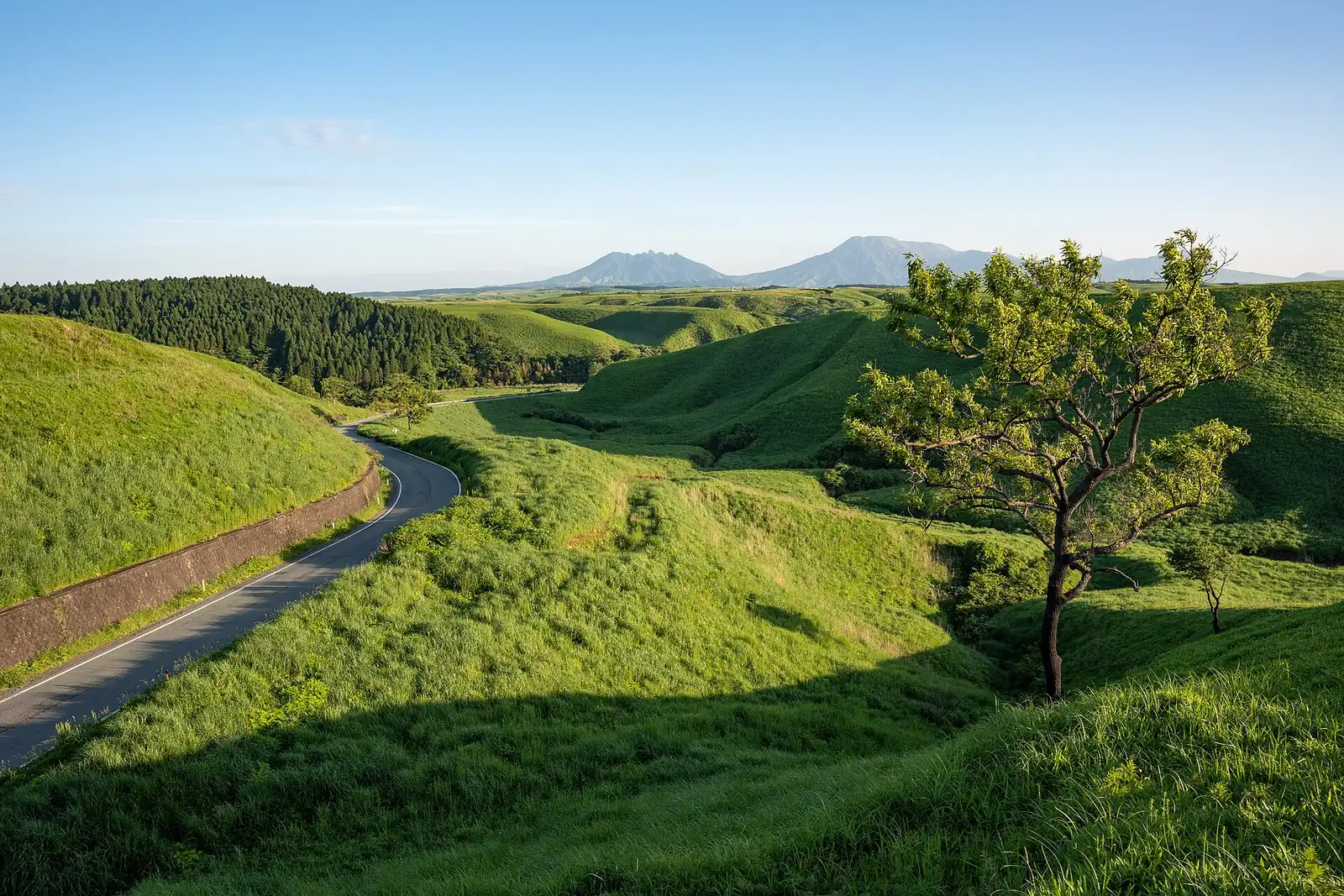
- Kyushu: Kurokawa, Yufuin and Aso. The Yamanami Highway, in the cover photo, crosses the grasslands between Aso and Kuju. With a car you can stay in Kurokawa and carry on to Yufuin or a quieter inn in the hills such as Tobise Onsen Tenga Sanso. Our Kurokawa guide and the Kyushu ryokan guide cover the towns.
- Shikoku: the Iya Valley. You can reach Iya by train and bus, and our Shikoku circuit does just that, but buses into the valley are few. A car opens up Oku-Iya and lets you stop where you like on the gorge road. Read the Iya Valley guide on the narrow roads first, and see the Iya Valley inns and the wider Shikoku list.
- Hokkaido. The distances are big. DoRaPuRa, NEXCO East's driving site, puts New Chitose Airport about 300 km from Hakodate and about 450 km from Shiretoko. A car joins up Noboribetsu, Jozankei, Niseko and the lake towns. Start with the best ryokans in Hokkaido.
- Tohoku. The hot springs of Akita, Aomori, Iwate and Yamagata are spread thinly across mountain country. Places like Tsurunoyu at Nyuto Onsen reward a car outside the snow months. See the Tohoku ryokan guide and the Tohoku region page.
- The Izu Peninsula. A car lets you link the east-coast towns with the inland valleys around Shuzenji and Amagi, and the quieter west coast. See ryokans in Izu and our Izu guide.
- Noto and Kaga, Ishikawa. The Kaga onsen towns and the Noto Peninsula are a drive from Kanazawa or Komatsu Airport. See the Ishikawa page and Yukemurinoyado Biwanso on Noto. Note the new ETC-only tollgates on the Hokuriku Expressway, covered below.
Where to skip it
- Tokyo and Kyoto. Trains and buses cover everything, and JNTO warns that parking can be hard to find in city centres. Pick the car up on the day you leave town.
- Hakone. The Hakone Freepass covers the trains, cable car, ropeway, lake boats and Hakone Tozan buses. The pass and the Romancecar from Shinjuku do the job better than a car; our Tokyo–Hakone–Kyoto route prices it out.
- A rail-pass trip. If most of your days are Shinkansen days, a car is an add-on for one rural leg at most. See rail passes for ryokan trips.
Licences: the rule that turns people away
Under Japan's Road Traffic Act, the National Police Agency (NPA) says you can drive only with one of these:
- a Japanese driving licence;
- an International Driving Permit (IDP) issued under the 1949 Geneva Convention on Road Traffic; or
- a licence from Switzerland, Germany, France, Belgium, Monaco or Taiwan, carried with an official Japanese translation (the list stood at these six on 1 April 2026).
If you need an IDP
- Get it at home, before you fly. JNTO says an IDP is valid only if it comes from the issuing authority in your country.
- It must be the booklet-type, paper permit. JNTO says card and smartphone versions are not valid in Japan. Toyota Rent a Car lists what its desks check: a 148 × 105 mm booklet, issued by a Geneva Convention country, printed with "Convention on Road Traffic of 19 September 1949", a photo, and a stamp on the vehicle class you may drive.
- Japan does not recognise IDPs in the 1968 Vienna, 1926 Paris or 1943 Washington Convention formats. It also rejects "international licences" from unauthorised bodies such as the IAA, including ones bought online (Toyota; All Japan Rent-a-Car Association).
- Validity. An IDP lasts one year from issue. In Japan you can drive on it for one year from your landing date, or until it expires, whichever is sooner (NPA). If you got it 11 months before the trip, you have one month.
- Get an entry stamp. The landing date is read from the stamp in your passport. JNTO and Toyota both warn that automated immigration gates don't stamp: ask staff for one, or the rental company may not be able to rent to you.
- At the desk you'll need the IDP and your passport together. The All Japan Rent-a-Car Association says that without both, a car cannot be rented to you even with a reservation, and it tells you to bring your driving licence on the day too.
If your licence is from one of the six
Drivers with a licence from Germany, France, Switzerland, Belgium, Monaco or Taiwan use it with a Japanese translation instead, and carry both at all times. The translation must come from the licensing authority or its embassy or consulate in Japan, or a body Japan recognises: JAF, ADAC for German licences, and the Taiwan-Japan Relations Association for Taiwanese ones (NPA). Toyota's list also includes the ALADDIN association and, for Taiwanese licences, Ziplus. A translation from anyone else does not count.
- JAF takes applications online only, and its standard online service doesn't accept applications from overseas; JAF's site has a separate page for people still outside Japan. Once applied, it averages 2 to 3 business days for these six countries. The fee for a translation to drive temporarily is ¥6,000; the ¥6,600 fee that started on 1 July 2026 is for translations used to convert to a Japanese licence.
- You can drive on the licence and translation for one year from entering Japan, or until your licence expires, whichever comes first.
JAF is clear that it doesn't decide whether a given IDP is valid. If yours looks unusual, ask the rental company before you fly.
Four Inns Worth the Drive
One inn in each of four of the driving regions above: Kurokawa in Kyushu, the Iya Valley in Shikoku, Nyuto Onsen in Tohoku and Niseko in Hokkaido. Check parking on each inn's own access page when you book.


Driving on the left, and the rules that differ
Japan drives on the left. The All Japan Rent-a-Car Association and JAF single out a few rules that trip up visitors:
- Stop signs mean a full stop. Stop at the line before a 止まれ (tomare) or STOP sign. If you skip it and cause a crash, you carry heavy responsibility.
- Stop at every railway crossing, look both ways, and don't enter until the car ahead is across.
- Right turns yield to oncoming traffic, even on a green light. Pedestrians always have right of way when you turn.
- No turn on red, unless a green arrow allows it.
- Default speed limits are 60 km/h on ordinary roads and 100 km/h on expressways when nothing is posted (JAF).
- Seatbelts for everyone and a child seat for any child under six. Rental companies hire out child seats; book them with the car.
- If the desk gives you a sticker saying a foreigner is driving, put it on the car where it can be seen. It asks the drivers around you to take care.
You must be 18 or older to rent a car in Japan, according to the All Japan Rent-a-Car Association.
Drinking and driving: plan around dinner
This matters more on a ryokan trip than anywhere else, because dinner is a long kaiseki that often comes with sake. Tokyo's Metropolitan Police tell drivers to never drive after drinking even a drop. The National Police Agency's penalties:
- Driving under the influence (a breath alcohol reading of 0.15 mg per litre or more): up to 3 years in prison or a fine of up to ¥500,000, and a licence suspension or revocation.
- Drunk driving: up to 5 years or ¥1,000,000, and licence revocation.
- Passengers who ride with a drinking driver, and anyone who served the alcohol, face up to 2 or 3 years and fines of up to ¥300,000 or ¥500,000. Whoever lent the car is treated like the driver.
In practice: arrive before dinner, park, and don't touch the car until morning. Alcohol can still be in your breath the next day after a late night, and the law applies whenever you drive. If one of you wants to skip the sake, that's the driver.
Booking the car
JNTO lists the national companies with English booking: Toyota Rent a Car, Times Car Rental, Nippon Rent-A-Car, ORIX Rent-A-Car, Nissan Rent a Car, plus Budget, JR Rent-A-Car (Ekiren), Hertz and Niconico Rent a Car. Between them they cover the airports and main stations you're likely to start from; Toyota alone has shops at New Chitose and Komatsu airports, for example. Book ahead online: the All Japan Rent-a-Car Association warns that the model you want may not be available if you just turn up.
Things to sort when you book:
- Options must be reserved in advance: ETC card, winter tyres, child seats, navigation and one-way drop-off (All Japan Rent-a-Car Association).
- Payment. Toyota stopped taking debit and prepaid cards for reservations made on or after 22 July 2026; use a credit card.
- Insurance. JNTO says you're required to buy insurance with a set level of cover when you rent. On top of that, companies sell waivers that cover what you'd otherwise pay after an accident. At Nippon Rent-A-Car the Collision Damage Waiver costs ¥1,100 a day on most classes.
- Breakdown help. Toyota rents out a JAF membership certificate (¥550 a rental), which gives you JAF's 24-hour road service with interpreting in 24 languages.
What it costs
Prices vary by company, season and shop, so treat these as examples, all including tax, from the companies' own price lists in October 2026:
| Company and class | Up to 24 hours | Each extra day |
|---|---|---|
| Times, K-0 kei car (N-BOX or similar) | ¥7,590 | ¥6,732 |
| Times, C-1 compact (Solio, Roomy or similar) | ¥8,855 | ¥7,920 |
| Toyota, C1 compact (Vitz, Passo, Roomy) | ¥10,340 (¥11,990 in Tokyo's 23 wards) | ¥8,690 |
Insurance waivers, options and peak-season surcharges are extra. Hokkaido summer rates apply at Toyota from 1 July to 31 August. JNTO's average for 24 hours in a sub-compact is ¥5,000 to ¥11,100.
Kei cars
The cheapest class is the kei car (軽自動車), a small car with an engine of 660 cc or less. Nippon Rent-A-Car's kei class (Wagon R, N-BOX and similar) seats four but is recommended for two, and its luggage guide is one carry-on-size bag in the smaller models and two in the taller N-BOX type. On the plus side, kei cars are easy on narrow onsen-town lanes and the Hokkaido and Tohoku expressway passes are cheaper for them. On the minus side, two people with big suitcases will be squeezed, and long expressway days are more tiring. For two people with luggage on a multi-day trip, we'd take a compact.
 A compact rental hatchback in Fukuoka, boot open. Photo: Meg Faibisch Kühn / Ryokan Finder (number plate blurred)
Tolls, ETC cards and the ETC-only tollgates
Most of Japan's expressways charge tolls, and they add up. JNTO's example is about ¥10,070 for one Tokyo–Kyoto route. In Hokkaido, DoRaPuRa quotes ¥1,430 from New Chitose Airport to central Sapporo and ¥5,530 to Hakodate, one way. Japan's own toll search tools (DoRaPuRa, NEXCO Central's Drive Compass) price a route before you go.
You pay at tollgates in one of two ways:
- 一般 (General) lanes: take a ticket on the way in, then pay cash or by credit card on the way out. Toyota notes that some gates take no cards, so keep some cash.
- ETC lanes: an ETC card in the car's reader pays automatically. Slow to 20 km/h or less and wait for the bar to lift.
Rent an ETC card. At Toyota it costs ¥550 per rental, the reader comes as standard in passenger cars, and you settle the tolls when you return the car. Japan is also converting tollgates to ETC-only, with no cash lane. NEXCO East and NEXCO Central keep adding them, and NEXCO Central's list already includes Komatsu and Mikawa ICs on the Hokuriku Expressway in Ishikawa. Kaga IC goes ETC-only on 1 December 2026, with Kanazawa-Morimoto (30 November), Kanazawa-Higashi (16 December, some lanes) and Hakusan (17 December) in the same batch. If you enter an ETC-only gate without a card, don't reverse. Drive on to the lane marked "ETC/サポート" or "サポート" (Support), stop and follow the staff's instructions (NEXCO East).
You'll also need an ETC card for any of the expressway passes below.
 Sagamihara IC on the Ken-O Expressway, one of the tollgates that is now ETC-only. Photo: さんどるぴん, CC BY-SA 4.0, via Wikimedia Commons (resized).
Expressway passes for visitors: what still exists
The pass that blogs still recommend, the nationwide Japan Expressway Pass, is no longer sold. JNTO says sales ended in December 2023. The Central Nippon Expressway Pass stopped taking new bookings on 1 October 2024. Five regional passes remain. All are for foreign passport holders, or Japanese nationals with permanent residence abroad, and you buy them with the rental car and an ETC card at a participating rental desk. Prices exclude the car and the ETC card. These are the operators' prices on 24 October 2026:
| Pass | Area | Days | Standard car | Kei car |
|---|---|---|---|---|
| Hokkaido Expressway Pass (HEP) | Hokkaido | 4 / 5 / 6 / 7 / 8 | ¥7,700 / ¥9,600 / ¥11,600 / ¥13,500 / ¥15,400 | ¥6,200 / ¥7,700 / ¥9,300 / ¥10,800 / ¥12,300 |
| Tohoku Expressway Pass (TEP) | Tohoku | 4 / 5 / 6 / 7 / 8 | ¥8,500 / ¥10,600 / ¥12,800 / ¥14,900 / ¥17,000 | ¥6,800 / ¥8,500 / ¥10,200 / ¥11,900 / ¥13,600 |
| San'in-Setouchi-Shikoku Expressway Pass (SEP) | Western Honshu and Shikoku | 3 to 10 | ¥10,700 (3 days) rising ¥1,000 a day to ¥17,700 (10 days) | No separate kei price listed |
| Kyushu Expressway Pass (KEP) | Kyushu | 2 to 10 | ¥6,200 (2 days), ¥8,400 (3), ¥10,600 (4), ¥12,800 (5) … ¥23,800 (10) | No separate kei price listed |
| Niigata Expressway Pass | Niigata | 3 | ¥6,200 | ¥4,900 |
Before you buy:
- Do the sums. DoRaPuRa's own examples put New Chitose to Asahikawa at ¥4,810 one way, so a 4-day HEP (¥7,700) pays only if you drive a fair amount. If you only drive from the airport to one inn and back, plain tolls can cost less.
- Dates are fixed. You can't extend the HEP or TEP partway through. For more than 8 days of HEP, NEXCO East says to buy two passes for back-to-back dates. The SEP counts calendar days, so 13:00 on 1 April to 13:00 on 4 April is three days of rental but four days of pass.
- Bridges cost extra on the SEP. It doesn't cover the Honshu–Shikoku bridge expressways. NEXCO West gives ¥2,670 or ¥3,340, depending on the day, for Kobe-Nishi to Naruto across Awaji.
- End dates. The Kyushu pass stops selling on 31 March 2027; plans start closing from 22 March 2027. The Tohoku pass takes applications until 31 March 2027. The HEP has no end date posted.
- Not every desk sells them. On 24 October 2026, NEXCO West's KEP page listed Toyota, Budget, ORIX and Nippon as not currently accepting KEP bookings; Times, Nissan and several Kyushu-based firms were taking them. Times takes pass applications in every area for a ¥330 handling fee on top of the pass, paid by credit card, though not every Times shop offers every pass. The Niigata pass is sold only at Toyota Rental & Leasing Niigata, and not during peak traffic periods.
Navigation: use the phone number
Rental cars come with satellite navigation. At Toyota it's standard on passenger classes, multilingual, and switches to English in the settings menu (設定・編集, then 言語設定). The easiest way to set a destination is the phone number. Enter the ryokan's number from its area code, starting with 0 and without the +81, and the system finds it. For a viewpoint or trailhead with no phone, enter its MAPCODE, a number of up to ten digits that pins a location. Newer Toyota cars also connect to Apple CarPlay and Android Auto. Note the inn's phone number when you book, and you're set. JNTO adds that main roads sign major destinations in English, but rural roads may not.
Phone maps work too, through CarPlay or Android Auto where the car has them. A Japanese eSIM keeps maps, calls and road-condition checks working on the move.
Fuel
Japan has full-service stations, where staff fill the car for you, and self-service ones (セルフ, "self"). The pumps are colour-coded (All Japan Rent-a-Car Association):
- Regular (レギュラー): red.
- High octane (ハイオク): yellow.
- Diesel (軽油, keiyu): green. Don't let the "kei" fool you: 軽油 is diesel, not fuel for kei cars.
Check your car's fuel type at pickup. A wrong fill can damage the engine, and the repair bill is yours. Return the car with a full tank. JAF warns that some expressways have no service station for long stretches. Service areas (SA), usually about every 50 km, have shops and restaurants and often fuel; parking areas (PA), about every 15 km, have toilets but not always more (All Japan Rent-a-Car Association). In the mountains, fill up when you see a station.
Parking at the ryokan
Don't assume. Before you book, check the inn's access page (アクセス) for whether it has parking, whether it's free, whether you need to reserve a space and how far the car park is from the door. If the page doesn't say, email and ask. It's worth knowing before you arrive in the dark.
Winter tyres and snow
 A rural road in Hokkaido in January. The striped poles mark the road edge when snow covers it. Photo: Sgroey, CC BY-SA 4.0, via Wikimedia Commons (resized).
Snowy roads need winter tyres (studless) or chains, says JNTO, and Toyota notes that some parts of Japan get snow from the end of September to May. In the snowiest areas the tyres come fitted. At Toyota, these shops fit them as standard in the dates shown, with seasonal rates:
| Area (Toyota Rent a Car, all shops unless noted) | Winter tyres standard |
|---|---|
| Hokkaido | 1 November to 5 May |
| Aomori, Akita, Iwate, Miyagi, Yamagata, Fukushima | 1 December to 31 March |
| Niigata, Nagano | 1 December to 31 March |
| Ishikawa, Toyama, Fukui | 15 December to 20 March |
| Tottori | 1 December to 15 March |
| Takayama Station shop (Gifu) | 1 December to 31 March |
Anywhere else, or outside those dates, you have to ask for them. At Toyota they cost ¥2,200 per 24 hours on passenger cars, and 4WD is another ¥1,650 per 24 hours where it's offered. The All Japan Rent-a-Car Association says winter tyres must be reserved in advance. That matters if you're picking up in Fukuoka, Osaka or Tokyo and driving up into snow, because the place you're going may have snow when the place you start doesn't.
How to drive in it, from the rental association's winter advice:
- Plan slack. Roads close and detours happen. Allow extra time and check forecasts and live road cameras for a few days before.
- Expect ice on bridges, overpasses and tunnel mouths, and at busy junctions where snow gets polished. Wet roads freeze at night and early in the morning.
- No sudden moves. Brake, steer and accelerate gently.
- Clear the snow off the roof, windows and mirrors before you set off, and off your shoes before you touch the pedals.
- Stand the wipers up when you park overnight, so they don't freeze to the windscreen.
If you've never driven on snow, think hard before a Hokkaido or Tohoku road trip in deep winter. A winter onsen reached by train may be the better trip. Our Hokkaido winter ryokan guide has ideas.
One-way rentals and drop fees
Dropping the car somewhere other than where you picked it up costs extra, and you must book it in advance (All Japan Rent-a-Car Association). Two examples from October 2026:
- Nippon Rent-A-Car charges ¥880 per 10 km between shops for passenger cars, kei cars included, and nothing under 20 km. In Kyushu it's ¥1,100 per 10 km from 15 July 2026. Hokkaido and Shikoku have their own tables, and a pickup or return at Noto Airport adds ¥7,700.
- Toyota and ORIX don't do one-way rentals between Hokkaido and the other main islands, or between Okinawa and elsewhere.
A loop that starts and ends at the same airport is usually the cheapest shape for an onsen road trip.
Sources
Checked 24 October 2026.
- National Police Agency: For Holders of Foreign Driver's Licenses (valid licences, the six translation countries and recognised translators as of 1 April 2026, the one-year period); Eradication of Drinking and Driving (thresholds and penalties).
- Tokyo Metropolitan Police Department: Let's Get Rid of Drinking and Driving!
- JAF: Driving in Japan with a foreign driver's license (Geneva IDP only, the Vienna format not valid, translation validity); translation applications (online only, processing times, fees from 1 July 2026); Traffic Rules in Japan (speed limits, child seats, fuel on expressways).
- JNTO: Things to know when renting a car (paper IDP only, entry stamps, rental companies, insurance, average prices, rules, toll example, end of the JEP and CEP); Expressway Passes (updated 22 January 2026).
- NEXCO East (DoRaPuRa): Hokkaido Expressway Pass (prices, eligibility, toll examples, distances); Tohoku Expressway Pass; Niigata Expressway Pass; ETC-only tollgates (support lanes, don't reverse).
- NEXCO West: Kyushu Expressway Pass (prices, end of sales, desks taking bookings); San'in-Setouchi-Shikoku Expressway Pass (prices, calendar days, bridge tolls).
- NEXCO Central: ETC専用料金所 (ETC-only tollgates) (current and scheduled ETC-only gates, including Komatsu and Kaga ICs).
- All Japan Rent-a-Car Association: Renting and returning (IDP and passport, age 18, options to reserve, fuel colours, drop-off); Traffic rules; Driving in winter.
- Toyota Rent a Car: Driver's licence requirements; Options (ETC card, JAF certificate, winter tyres, 4WD, child seats); Shops with winter tyres as standard (as of 31 August 2026); Car navigation (phone number, MAPCODE); One-way rentals; Price list; home page notice on debit and prepaid cards (9 July 2026).
- Times Car Rental: Kei and compact prices (Japanese); Expressway pass handling.
- Nippon Rent-A-Car: Kei and standard classes (660 cc, capacity, CDW); One-way fees.
- ORIX Rent-A-Car: One-way rentals.
Photo credits
- Cover: "Yamanami Highway" by Raita Futo, CC BY 2.0, via Wikimedia Commons. The road linking Aso and Kuju, in Aso, Kumamoto. Resized.
- ETC tollgate at Sagamihara IC by さんどるぴん, CC BY-SA 4.0, via Wikimedia Commons. Resized.
- Compact rental car in Fukuoka: Meg Faibisch Kühn's own photo. Cropped, number plates blurred.
- Hokkaido winter road by Sgroey, CC BY-SA 4.0, via Wikimedia Commons. Resized.


Free ryokan planning guide
Japan travel tips, etiquette essentials, and our top picks — straight to your inbox.
Explore Top Ryokans
Discover highly rated traditional Japanese inns
Ready to book your ryokan?
Check dates, rooms and current rates for ryokans across Japan.
Planning a ryokan stay?
Get our free Japan ryokan planning guide — packing tips, etiquette, and our top picks by region.
No spam. Unsubscribe anytime.
Related guides
- Best Winter Onsen Ryokans in JapanWinter is the secret best season for ryokan stays. Snow-viewing baths, off-peak rates, and the pure magic of yuki-mi onsen. Where to go and when to book.
- Costco in Japan: what travelers should knowYour home membership works, but your Visa doesn't. A practical look at Costco Japan for visitors: fees, payment rules, all 37 warehouses and the ones you can reach without a car, the 180-yen hot dog, shipping, and whether it's worth the trip.
- Best Ryokans in Shikoku: The Pilgrimage IslandShikoku — Japan's fourth-largest island — is famous for the 88-temple pilgrimage but has exceptional ryokans at Dogo Onsen, in the Iya Valley, and along the Pacific coast. Dramatically undervisited by international travelers.
Ryokan Finder Editorial
We research and organize traditional Japanese inns across the country. About Ryokan Finder