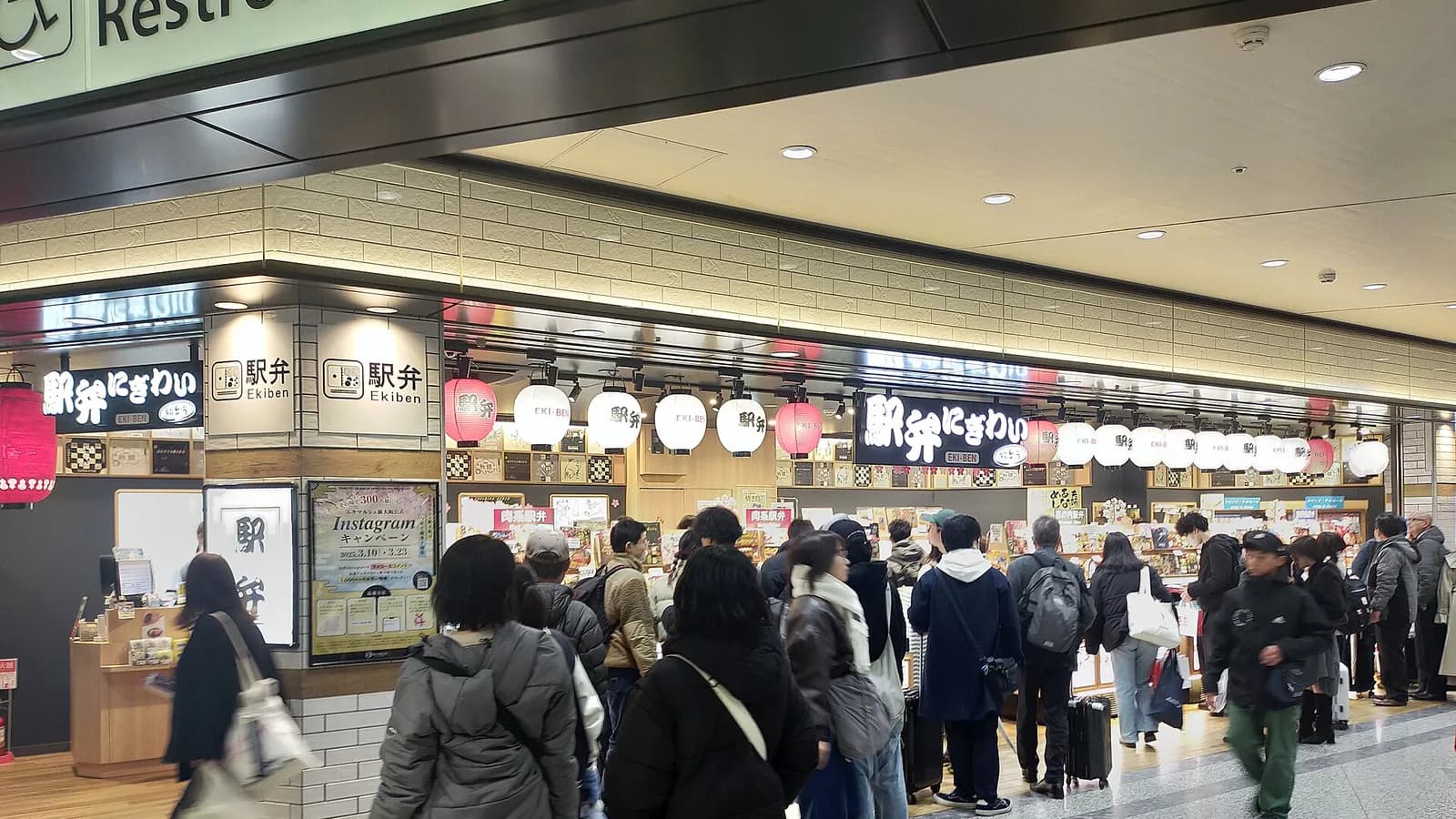
An ekiben (駅弁) is a station bento: a boxed meal sold at a station to eat on the train. Some are just good lunch boxes. The famous ones are regional dishes, sold for decades at one station, in packaging people collect, and a few are reasons to take the train at all.
This guide covers a handful of classics, where to buy them, how to eat on a Japanese train without annoying anyone, and how to survive the big stations you'll buy them in: their food halls, lockers, IC cards and signs. Details were checked against each company's own site in October 2026.
How ekiben work
You buy an ekiben before you board, at a shop inside the ticket gates or on the platform, and eat it on a shinkansen or limited express train, where seats face forward and have tray tables. Most are designed to be eaten cold. The rice is cooked to taste good at room temperature, and the box keeps everything in place. Some come with a heating pack (see the gyutan bento below).
Ekiben are a regional pleasure: each is made by a local company and many are sold only along one line. Big terminals now sell ekiben from all over the country, so you can try Hokkaido's or Toyama's from a Tokyo platform.
Five classics
Ikameshi, Mori (Hokkaido)
 The ikameshi box from Ikameshi Abe Shoten, Mori. Photo: Gpx-evo, CC BY-SA 4.0, via Wikimedia Commons (resized).
Ikameshi (いかめし) is squid stuffed with a mix of ordinary and glutinous rice and simmered in sweet soy sauce. It was invented in 1941 at Mori, a small station on the Hakodate Line, by Ikameshi Abe Shoten, which has sold ekiben there since the station opened in 1903. Japan's agriculture ministry tells the story: in wartime, with rice rationed, the founder's wife came up with a way to stretch it using squid, then plentiful.
Today the platform sellers only appear for about two weeks from mid-August. The rest of the year, Abe Shoten sells ikameshi at the Shibata shop in front of Mori Station and a Lawson nearby, and it turns up at ekiben fairs in department stores across Japan. Abe Shoten also sells it online.
Toge no Kamameshi, Yokokawa (Gunma)
 Toge no Kamameshi on display at an Oginoya shop. Photo: tomihiro, CC BY 3.0, via Wikimedia Commons (resized).
Oginoya began selling food at Yokokawa Station in 1885, which it says makes it the second-oldest ekiben business in Japan after Utsunomiya. In 1958 Oginoya launched Toge no Kamameshi (峠の釜めし, "kamameshi of the pass"): seasoned rice under a mix of toppings, served in a Mashiko-ware earthenware pot. Oginoya's fourth president, Takamizawa Mineji, created it after asking travellers on the platform what they wanted from an ekiben; the answer was something warm and homely. It has sold about 170 million.
The heavy pot is part of the appeal, and plenty of people take it home. At stations Oginoya now sells the kamameshi only in a lightweight pulp container. For the pot, go to an Oginoya shop or drive-in. In Tokyo, look for it at Ekibenya Odori in Gransta Tokyo.
Masu no sushi, Toyama
 Minamoto's masu no sushi, with the bamboo leaves opened. Photo: くろふね, CC BY 4.0, via Wikimedia Commons (resized).
Masu no sushi (ますのすし) is pressed trout sushi: a disc of vinegared rice topped with trout, wrapped in bamboo leaves inside a round wooden box. Minamoto, a Toyama inn and restaurant family, got permission to sell food in Toyama Station when it opened in 1908 and launched its masu no sushi as the station's ekiben in 1912. Its box with a trout painted by Nakagawa Kazumasa, introduced in 1965, is still used.
You cut it like a cake with the plastic knife in the box. The standard one-tier box costs 2,200 yen. Minamoto's shop by the central ticket gate at Toyama Station opens 6:30 to 20:00, and it also sells at Ekibenya Matsuri in Tokyo Station, though not every day.
Gyutan bento, Sendai
 A Sendai beef bento with miso-grilled beef tongue, bought at Sendai Station. Photo: くろふね, CC BY-SA 4.0, via Wikimedia Commons (cropped and resized).
Sendai is famous for gyutan, grilled beef tongue, and its station sells it every way. The best-known ekiben is Kobayashi's Sendai Meibutsu Gyutan Bento (仙台名物牛たん弁当): thick-cut tongue matured in a salt marinade, on barley rice, in a self-heating box. Pull the string on the side and in a few minutes it's hot. Kobayashi sells its ekiben at shops all over Sendai Station and at Ekibenya Matsuri in Tokyo Station.
Gyuniku Domannaka, Yamagata
If you want one to start with, Gyuniku Domannaka (牛肉どまん中), a beef-on-rice bento from Shinkineya in Yamagata Prefecture, was the number one seller in JR East's ranking for Ekibenya Matsuri at Tokyo Station.
Ryokans Near the Stations
Inns close to Tokyo, Shinjuku, Kyoto, Kanazawa and Hakodate stations, and one in Sendai's hot spring.


Where to buy them
- Tokyo Station: Ekibenya Matsuri (駅弁屋 祭) in Gransta Tokyo, on the ground-floor central passage inside the ticket gates, stocks more than 150 kinds of ekiben and opens 5:30 to 22:00 every day. It's close to the transfer gates for the Tokaido Shinkansen and the JR East lines. Ekibenya Odori (駅弁屋 踊) nearby, 6:00 to 21:00, stocks Matsuri's top sellers.
- Shinjuku: Ekibenya Matsuri Select, inside the JR south gate, 6:30 to 21:00.
- Sendai: Ekibenya Matsuri on the second-floor concourse outside the central gate, 7:00 to 20:00, plus kiosks inside the shinkansen gates.
- Toyama: Minamoto's shop by the central ticket gate, 6:30 to 20:00.
- Shin-Osaka: the cover photo shows Ekiben Nigiwai, the ekiben shop in Eki Marche Shin-Osaka, crowded on a March evening.
- Department-store ekiben fairs: every January and February, department stores hold big ekiben fairs with sellers from all over the country. Keio's Shinjuku store in Tokyo and Hanshin's Umeda store in Osaka hold two of the best known.
Ekiben sell out, especially at lunchtime and before the evening rush, so buy early for the famous ones. JR East's JRE MALL Order lets you pre-order some and collect them in the station.
Eating on a Japanese train
- Long-distance trains, yes. On the shinkansen and limited express trains, eating is normal. JR East and JR West ask only that you think of the people around you. Avoid very strong smells if the train is packed.
- Local trains, no. On commuter and subway trains with long bench seats, people don't eat. Wait until you're at your destination.
- Take your rubbish with you. Use the bins on board, usually in the deck between cars, or at the station. Bins are rare on the street in Japan, so a spare bag helps.
- Heat it right. With a self-heating box, pull the string, put the box down on the tray table and leave it for the time on the label. Don't hold it while it heats, and don't open it until the time's up.
- Drinks. A can of beer with an ekiben is a Japanese tradition. Keep it to one.
Our shinkansen guide has the rest of the on-board manners, and our konbini guide covers the cheaper option of an onigiri and a tea.
Surviving the big stations
Japan's big stations are towns in their own right, with shopping centres above and below the platforms. Shinjuku is the busiest railway station in the world: Guinness World Records puts its throughput at an average of 2,704,703 passengers a day in 2022, across lines run by JR East, Keio, Odakyu, Toei Subway and Tokyo Metro. JR East's own figures for fiscal 2024 put boardings at its Shinjuku platforms alone at 666,809 a day, ahead of Ikebukuro and Tokyo.
Find your exit before you arrive
The single most useful thing in a big station is to know which exit you want. Hotels, ryokan and restaurants usually say "X minutes from the East Exit" or "the Yaesu side". Yellow signs point to exits, and the big stations also show station numbering, a letter and number for each line and stop (Shinjuku on the JR Yamanote Line is JY17), which makes the lines easy to follow even if you can't read Japanese. If you're meeting someone, agree on one named exit.
At Tokyo Station, remember the two sides: the red-brick Marunouchi side faces the Imperial Palace, and the Yaesu side faces Nihonbashi and the long-distance bus stops. The JR East shinkansen and the JR Central Tokaido Shinkansen have separate gates.
Food halls
The food halls inside and under big stations are some of the best places to eat in Japan. In Tokyo Station, Gransta Tokyo, inside and outside the gates, has bento, sweets and bakeries. Department-store basements next to the big stations, known as depachika, have the same and more. At Kyoto Station, the ASTY Kyoto shops on the shinkansen (Hachijo) side and the Porta underground mall on the north side are the places to pick up food for the train. Our bakery guide covers the bread counters.
Coin lockers and luggage storage
- Sizes. Lockers come in small, medium and large, and the large ones take a mid-sized suitcase. The biggest suitcases often don't fit, which is one more reason to send them ahead.
- Payment. Many take transport IC cards: with a Welcome Suica you pay and use the card as the key. JR East's Multi-Ecube lockers are cashless only, and older ones take coins. Keep the receipt, which shows the locker's location.
- Finding a free one. At Tokyo Station you can check Suica locker availability online and in the Tokyo Station Navi app. Kyoto Station has around 1,505 lockers on the shinkansen (Hachijo) side, open 24 hours, each bank marked with one of 13 flower stickers so you can find yours again, and JR West runs an online search for free ICOCA lockers at Kyoto, Osaka and Shin-Osaka stations.
- Staffed storage. Tokyo Station has a JR East Travel Service Center baggage storage at the Marunouchi North exit and a cloak service in the basement of Gransta Tokyo. Kyoto Station's ASTY Kyoto offers luggage delivery to hotels as well as storage.
- Better still, ship it. If you're moving on to a ryokan, takkyubin delivery takes the bag off your hands for a day or two. Our shinkansen guide explains how.
IC cards
A transport IC card is the easiest way through a big station: tap in and tap out, and the fare comes off the card. Suica (JR East), PASMO (Tokyo's other lines) and ICOCA (JR West) work on each other's networks in most of the country, and in shops, vending machines and lockers.
- Welcome Suica Mobile, JR East's app for visitors, was released for iPhone on 6 March 2025. You issue and top up a Suica in the app, before or after you arrive, with no membership, and it's valid for 180 days. Since October 2025 it has linked to JR-EAST Train Reservation for shinkansen tickets, and since March 2026 you can buy Green Car tickets for JR East local trains in it.
- Welcome Suica cards, valid for 28 days, are sold at airport stations and JR East Travel Service Centers in Tokyo, Shibuya, Shinjuku, Ikebukuro, Ueno, Yokohama and Sendai.
- One trip, one area. JR East says an IC card can't be used for a trip that crosses from one IC area into another. Buy a paper ticket for those.
The shinkansen needs a separate ticket, unless you've linked a booking to your card. Our shinkansen guide explains tickets, and the Japan Rail Pass guide covers passes.
Ekiben around a ryokan stay
- Lunch, not dinner. If your ryokan stay includes dinner, eat your ekiben at lunchtime on the way and keep it light. A kaiseki dinner starts around 18:00 and runs to ten courses or more. Our ryokan dinner guide explains it.
- The morning after. A ryokan breakfast is big and served at a fixed time. Our ryokan breakfast guide explains it. After it, you won't want an ekiben until mid-afternoon. Buy one for the later train instead.
- Rural stations close early. In onsen towns the station shop may shut by late afternoon. Buy your ekiben at the big station where you change.
- Plan the route around the food. Our Japan ryokan itinerary strings ryokan stays together by train. Sendai, Toyama and Hakodate all make good stops.
Ryokans near the stations
- Hoshinoya Tokyo is a 17-storey ryokan in Otemachi, a short walk from the Marunouchi side of Tokyo Station and Ekibenya Matsuri.
- Onsen Ryokan Yuen Shinjuku opened in 2019, with an 18th-floor open-air bath of hot spring water trucked in from Hakone, five minutes from Shinjuku Gyoen.
- Matsubaya Ryokan was founded in 1884 at the gate of Higashi Honganji and rebuilt in 2008, ten minutes on foot from Kyoto Station.
- Akiu Onsen Hotel Kiyomizu is in Akiu Onsen, Sendai's hot spring, with large and open-air baths in both its buildings and three detached rooms with their own baths and gardens. Pick up your gyutan at Sendai Station.
- Kanazawa Chaya is three minutes from Kanazawa Station, the next big stop after Toyama on the Hokuriku Shinkansen, with Kaga cuisine and large baths.
- Hakodate Henmi Ryokan has six tatami rooms six minutes' walk from JR Hakodate Station, the junction for the line to Mori. It's room only, cash only and adults only.
Sources
Checked October 2026.
- Ikameshi Abe Shoten: the ikameshi story (1903, 1941, where to buy; Japanese); Ministry of Agriculture, Forestry and Fisheries, ikameshi (wartime origin, ingredients; Japanese).
- Oginoya: history (1885, second oldest after Utsunomiya, 1958); Toge no Kamameshi (170 million sold); Oginoya Tokyo (Mashiko ware); shops (pulp container at stations, Ekibenya Odori; Japanese).
- Minamoto: history (1908, 1912; Japanese); masu no sushi (price, 1965 package; Japanese); Toyama Station shops and stockists (Japanese).
- Kobayashi: where to buy (Sendai and Tokyo shops, department-store fairs; Japanese).
- Gransta (JR East): Ekibenya Matsuri (150+ kinds, hours, location); Ekibenya Odori (Japanese).
- JRE MALL Order: ekiben shops (Shinjuku, Sendai hours; Japanese).
- JRE Media (JR East): Sendai Ekibenya Matsuri (gyutan bento, location); Ekibenya Matsuri ranking (Gyuniku Domannaka; Japanese).
- JR East: manners (eating on board, luggage; Japanese); Welcome Suica (lockers); where to buy Welcome Suica; Welcome Suica Mobile and release; Green Car tickets in Welcome Suica Mobile; Suica areas (Japanese).
- JR West: manners (Japanese); ICOCA locker search (Japanese).
- JR East Smart Logistics: Multi-Ecube lockers.
- Tokyo Station City: station map, lockers and baggage storage.
- ASTY Kyoto: coin lockers and luggage service and lockers (1,505 lockers, 24 hours; Japanese).
- Guinness World Records: busiest railway station.
- Nippon.com: JR East's busiest stations, fiscal 2024.
Photo credits
- Cover: "Ekiben Shop Nigiwai at Eki Marche Shin-Osaka" by Mr.ちゅらさん, CC BY 4.0, via Wikimedia Commons. Cropped and resized.
- Ikameshi by Gpx-evo, CC BY-SA 4.0, via Wikimedia Commons. Resized.
- Toge no Kamameshi by tomihiro, CC BY 3.0, via Wikimedia Commons. Resized.
- Masu no sushi by くろふね, CC BY 4.0, via Wikimedia Commons. Resized.
- Sendai beef tongue bento by くろふね, CC BY-SA 4.0, via Wikimedia Commons. Cropped and resized.


Free ryokan planning guide
Japan travel tips, etiquette essentials, and our top picks — straight to your inbox.
Explore Top Ryokans
Discover highly rated traditional Japanese inns
Ready to book your ryokan?
Check dates, rooms and current rates for ryokans across Japan.
Planning a ryokan stay?
Get our free Japan ryokan planning guide — packing tips, etiquette, and our top picks by region.
No spam. Unsubscribe anytime.
Related guides
- Japanese bakeries: melonpan, curry bread and the tray-and-tongs ritualWhat to buy in a Japanese bakery, from anpan and melonpan to curry bread, shokupan and sando, how the tray-and-tongs system works, the old bakeries worth a detour in Tokyo, Yokohama, Kyoto, Kobe and Hiroshima, depachika bread counters and the seasonal specials.
- Matcha in Japan: where to drink it and what to bring homeWhere to drink matcha in Uji, Kyoto, Tokyo and Kanazawa, from the old Uji tea houses to a municipal tea room facing the Byodo-in. Usucha and koicha explained, what to do at a tea ceremony, the sweets that come with it, and how to buy and keep tea to take home.
- A guide to the Japanese konbiniWhat to eat at 7-Eleven, FamilyMart and Lawson, how to pay, which ATMs take your card, the bag fee and the heating question, shipping a suitcase, tax-free after 1 November 2026, and how to use a konbini around a ryokan stay.
Ryokan Finder Editorial
We research and organize traditional Japanese inns across the country. About Ryokan Finder