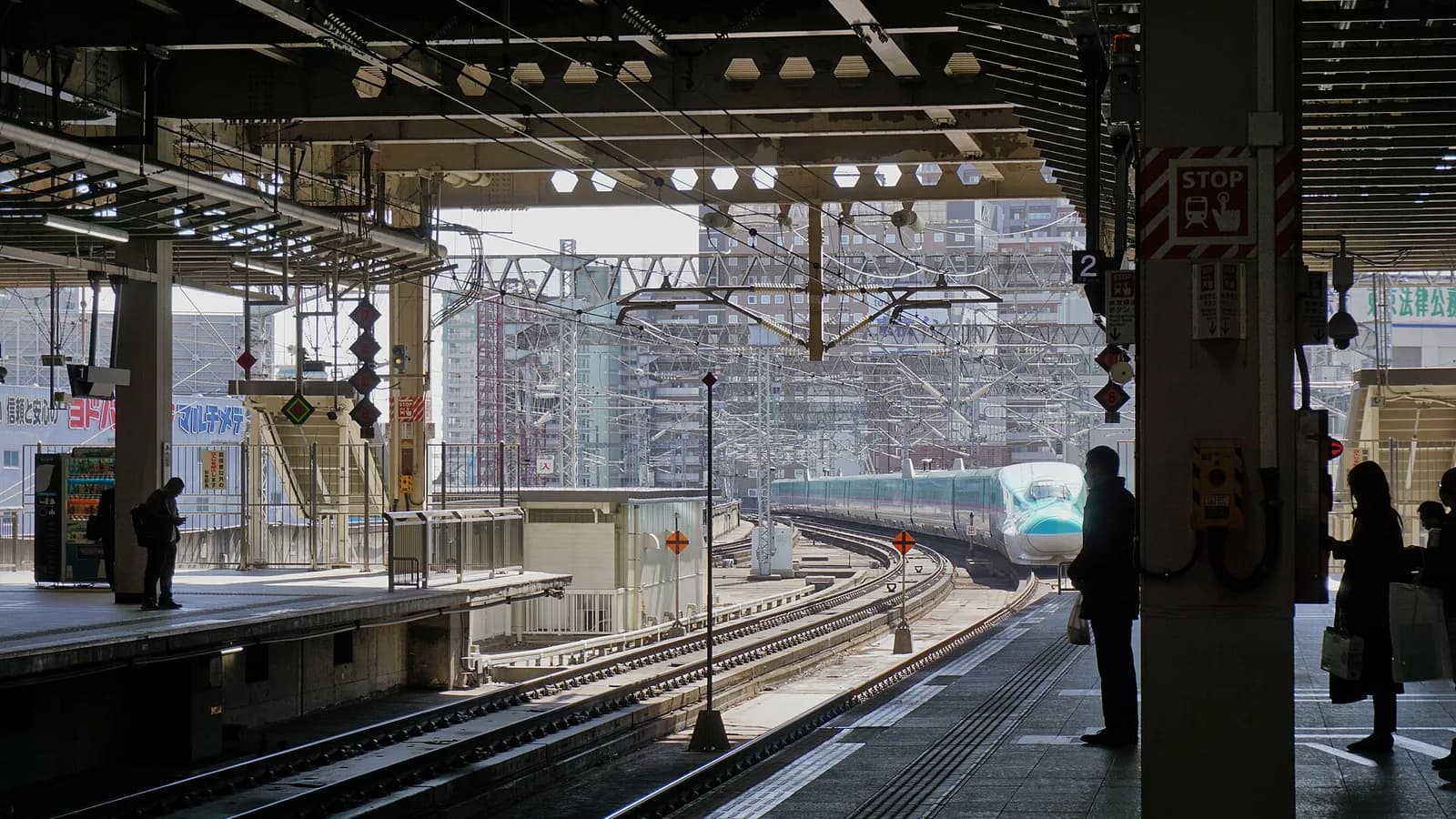
The shinkansen is the easiest way to travel between Japan's cities, and on most routes it's faster door to door than flying. It's also simple to use once you know the few rules that trip visitors up: which train to take, whether you need a reservation, what to do with a big suitcase, and where to sit for Mount Fuji.
This guide covers those, with ticket and luggage rules checked against the JR companies' own sites in October 2026. It doesn't cover the Japan Rail Pass. Our Japan Rail Pass guide explains when a pass pays and how it works with ryokan stays.
The lines
Several JR companies run the network, and which one runs your train decides some of the rules below.
- Tokaido Shinkansen, Tokyo to Shin-Osaka via Nagoya and Kyoto, run by JR Central. The fastest trains take 2 hours 21 minutes between Tokyo and Shin-Osaka.
- Sanyo Shinkansen, Shin-Osaka to Hakata (Fukuoka) via Kobe, Okayama and Hiroshima, run by JR West. Many trains run through from Tokyo.
- Kyushu Shinkansen, Hakata to Kagoshima-Chuo, and the Nishi-Kyushu Shinkansen, Takeo-Onsen to Nagasaki, run by JR Kyushu.
- Tohoku Shinkansen, Tokyo to Shin-Aomori via Sendai, continuing as the Hokkaido Shinkansen to Shin-Hakodate-Hokuto. The Yamagata and Akita lines branch off it.
- Joetsu Shinkansen, Tokyo to Niigata.
- Hokuriku Shinkansen, Tokyo to Nagano, Kanazawa and Tsuruga. The Kanazawa to Tsuruga section opened in 2024.
The Tohoku, Hokkaido, Yamagata, Akita, Joetsu and Hokuriku lines leave from the JR East side of Tokyo Station. Everything else is JR Central and JR West.
Train names
Each line has fast and slow services with their own names. The name is on your ticket and the departure boards.
- Tokaido and Sanyo: Nozomi is the fastest and stops least. Hikari stops a little more. Kodama stops everywhere. Between Shin-Osaka and Kyushu you'll also see Mizuho and Sakura, and on the Kyushu line Tsubame.
- Tohoku and Hokkaido: Hayabusa is the fastest, then Hayate, Yamabiko and Nasuno, the local service. The Yamagata line is Tsubasa.
- Hokuriku: Kagayaki is the fastest and all-reserved. Hakutaka stops more and has non-reserved seats in cars 1 to 4. Asama runs to Nagano, and Tsurugi shuttles between Toyama, Kanazawa and Tsuruga.
- Joetsu: Toki and Tanigawa.
If you're going somewhere the Nozomi or Hayabusa doesn't stop, take the slower train rather than changing.
Ryokans on the Shinkansen Routes
Inns a short hop from a shinkansen stop on the Tokaido, Sanyo, Hokuriku and Tohoku lines.


Tickets
A shinkansen journey needs two parts: the basic fare, and a limited express ticket for the shinkansen itself, which is either reserved or non-reserved. When you buy online or at a machine, both come together.
Online
- smartEX covers the Tokaido, Sanyo and Kyushu Shinkansen. You register with a credit card, book in English, choose your seat on a seat map, and board by linking your ticket to an IC card such as Suica, or collect paper tickets at a station machine. smartEX takes bookings up to a year ahead.
- JR-EAST Train Reservation covers JR East's lines (Tohoku, Hokkaido, Yamagata, Akita, Joetsu and Hokuriku). Since 1 October 2025 the Welcome Suica Mobile app, JR East's Suica app for visitors on iPhone, has linked to it, so you can book a shinkansen e-ticket and board by tapping your phone.
Online booking is the easiest way to pick a seat with an oversized baggage area or the Mount Fuji side.
At the station
- Reserved-seat ticket machines (指定席券売機) have an English menu, take cards and cash, and show a seat map. They're the quickest option if you know your train.
- Ticket offices, the JR "midori no madoguchi" and JR East's Travel Service Centers at the big stations, sell everything, but queues can be long in the morning and at holidays.
Reserved tickets bought at stations go on sale one month before the travel date, at 10:00.
 Shinkansen ticket machines at Kyoto Station's central transfer gate, June 2026. Photo: Sashimiteishoku, CC0, via Wikimedia Commons (resized).
Reserved or non-reserved
Most trains have non-reserved cars (jiyūseki), where you sit wherever there's space, and the rest are reserved (shiteiseki). A Nozomi normally has two non-reserved cars, 1 and 2. A non-reserved ticket is a little cheaper, but you may stand.
Reserve if you can, and always reserve if:
- You're travelling at a peak time. JR Central and JR West run every Nozomi as all-reserved in the busiest periods. For 2026–27 those are 24 April to 6 May, 7 to 16 August, 18 to 23 September, 10 to 12 October, 21 to 23 November, 25 December to 5 January, 9 to 11 January and 20 to 22 March. A non-reserved ticket then only lets you stand in the deck. Hikari, Kodama and the other trains keep their non-reserved cars.
- You have a big suitcase (see below).
- You want the Fuji side, or a group wants to sit together.
If you miss a reserved train, the rules depend on the ticket. Check before you buy. Discount online tickets usually have to be changed before departure.
Green Car, Gran Class and Supreme Class
- Green Car (グリーン車) is first class: wider seats, two and two across, more legroom and a quieter car. Every line has one, and on the Tokaido Shinkansen every Green Car seat has a power socket.
- Gran Class (グランクラス), on JR East's Series E5 and H5 trains (Tohoku and Hokkaido) and E7 and W7 trains (Hokuriku and some Joetsu services), is a level above, with leather seats in a two-and-one layout. On some trains an attendant serves drinks and a light meal. On others, including all Hakutaka and Asama trains and Hayabusa trains running only between Tokyo and Sendai, it's seat only.
- Supreme Class (スプリームクラス) started on 1 October 2026 on the Tokaido and Sanyo Shinkansen. It's a private cabin with a lockable door on some N700S trains: one for up to two people in car 7 and one for one person in car 10, with a reclining seat with a leg rest, its own lighting and climate controls, and complimentary food and drink on Nozomi and Hikari services. It costs well above a Green Car and is sold only as a ticketless booking through smartEX and the Express reservation service, from one month before travel. A semi-private Supreme Class seat is due during fiscal 2027.
Luggage
Tokaido, Sanyo, Kyushu and Nishi-Kyushu
These lines have a strict rule for large bags. Add up the length, width and height of each bag, including wheels and handles.
- Up to 160 cm: no reservation needed. Use the overhead rack, or the space at your feet.
- 161 to 250 cm: you must reserve a seat with an oversized baggage area, a seat in the back row of certain cars, with the space behind it for your bag. It costs the same as an ordinary reserved seat. Board without one and you pay a 1,000 yen fee and put the bag where the crew tells you.
- Over 250 cm: not allowed on board.
JR Central says the 160 cm line is about the size at which airlines start charging for oversized bags, so a large suitcase for a long trip may well be over it. The rule applies on these lines whatever ticket or pass you have, and these seats sell out at busy times, so book them early. Since July 2025, some decks on 16-car Tokaido and Sanyo trains have also had an oversized luggage corner you can use without a reservation, on a trial basis.
JR East lines
JR East's lines have no reservation rule. There are luggage areas in or beside some cars, free and first come, first served, and some trains have none. In ski season they fill up.
Send it ahead
The simplest answer to a big bag is not to take it. Takkyubin, door-to-door delivery, will send it to your next hotel or ryokan. Yamato Transport's TA-Q-BIN usually delivers the next day, or two days later over long distances. You can send from a hotel front desk, many ryokan, a Yamato office or a 7-Eleven or FamilyMart.
- To a hotel or ryokan, send it so it arrives at least the day before your stay, and tell the inn. Put your name and check-in date on the waybill.
- To the airport, drop it off two days before your flight (three in some areas).
- Same-day delivery from some airport and station counters (Haneda Airport and Kyoto Station among them) to hotels in the city. You drop off in the morning and collect it on check-in.
Our konbini guide explains how to send a bag from a convenience store.
The Mount Fuji seat
On the Tokaido Shinkansen between Tokyo and Osaka, book seat E in an ordinary car or seat D in the Green Car. JR Central's own advice is that seat E faces Mount Fuji whichever way you're going. Fuji is on the right leaving Tokyo and on the left heading back, but the seat letters are fixed to one side of the train, so E is always on the mountain's side.
The mountain shows briefly between Shin-Yokohama and Odawara, then properly between Mishima and Shin-Fuji, about 40 to 50 minutes out of Tokyo on a Nozomi, where the line crosses Fuji's southern foot. The view lasts a minute or two, and only on a clear day, which is more likely in winter. Pick your seat on the seat map online or at a ticket machine.
On board
- Find your car. Platform markings show where each car stops. Queue in line at your car number before the train comes in.
- Boarding is quick. Trains stop for only a minute or two at intermediate stations. Have your bags ready and get on promptly.
- Phone on silent; calls in the deck. JR West asks passengers to keep phones on silent mode and not make calls on board. The exceptions are the Tokaido and Sanyo Shinkansen's S Work cars and JR East's TRAIN DESK cars, set aside for work, where quiet calls and web meetings at your seat are allowed.
- Recline gently. JR Central has no rule on reclining, but asks you to bear in mind the person behind. A quick look back, or a word, before you recline is normal.
- Turn the seats round. Rows can be rotated to face each other for a group. Turn them back when you get off.
- Eat as you like. Bento on the train is a Japanese institution, and our ekiben and station guide explains what to buy and where. Keep strong smells in mind, and take your rubbish to the bins on board or at the station.
- Wi-Fi and power. Free Wi-Fi runs on every Tokaido Shinkansen train. In ordinary cars there are power sockets at the window seats and the front and back rows. The newest trains have them at every seat.
- Quiet is normal. Talking is fine, but keep the volume down. Many trains are near-silent first thing in the morning.
Shinkansen around a ryokan stay
The shinkansen is how most visitors reach ryokan country, and a few habits make the day easier.
- Check-in is usually from 15:00. A mid-morning train leaves time for lunch and a short walk before you arrive. Don't book the last train of the evening if dinner is included, because most ryokan serve it from about 18:00. Our ryokan dinner guide explains the timing.
- Breakfast first, then the train. The ryokan breakfast is served at set times, so book a train for an hour or two after it ends.
- Send the big bag ahead (see above), and travel with an overnight bag. Many ryokan corridors and rooms aren't built for large suitcases.
- Allow for the last leg. Many onsen towns are a local train or bus from the shinkansen station: Atami and Arima are easy, but somewhere like Shuzenji needs a change. Our Japan ryokan itinerary shows how to string stays together.
Ryokans on the shinkansen routes
- Atami Sekitei has 24 mostly detached sukiya rooms in a stone garden and three hot spring sources of its own. Atami is a Tokaido Shinkansen stop.
- Shuzenji Onsen Kikuya Ryokan is a mid-range inn in Shuzenji, the hot spring temple town at the heart of the Izu Peninsula. Change at Mishima, one stop past Atami, for the Izuhakone Railway.
- Arima Onsen Nakanobo Zuien has received guests since 1868 in Arima Onsen, in the hills behind Kobe. Get off the Sanyo Shinkansen at Shin-Kobe.
- Ryokan Onomichi Nishiyama reopened in 2023 with 11 rooms, eight of them detached houses round a garden over the sea. Onomichi is on the Sanyo line between Okayama and Hiroshima, reached from Shin-Onomichi or Fukuyama.
- Kanazawa Chaya is three minutes from Kanazawa Station on the Hokuriku Shinkansen, with 18 tatami rooms, Kaga cuisine and large baths.
- Akiu Onsen Sakan is a large Akiu Onsen inn in a 26,000 square metre garden, about 30 minutes from Sendai, the Tohoku Shinkansen's main stop.
Sources
Checked October 2026.
- Central Japan Railway (JR Central): Shinkansen guide (journey time, Mount Fuji seat, Wi-Fi, power sockets); Mount Fuji from the Tokaido Shinkansen; oversized baggage; Nozomi all-reserved peak periods and in Japanese (train names, sale dates); Supreme Class; Fact Sheets 2026.
- JR Central and JR West: Supreme Class press release (Japanese).
- West Japan Railway (JR West): oversized luggage; train and station manners.
- Kyushu Railway (JR Kyushu): oversized baggage.
- smartEX (Tokaido Sanyo Kyushu Shinkansen Internet Reservation Service): taking baggage on board; luggage corner trial from July 2025.
- East Japan Railway (JR East): oversized luggage guide; FAQ; Hokuriku Shinkansen (train names, Tsuruga extension); GranClass and trains without meal service; Welcome Suica Mobile and JR-EAST Train Reservation (Japanese); TRAIN DESK (Japanese); Welcome to Japan: luggage on JR East.
- Railway Fan (railf.jp): Supreme Class launch (booking channels and sale dates; Japanese).
- Bengo4.com: JR Central on reclining seats (Japanese).
- Asahi Shimbun: Nozomi all-reserved on three-day weekends from October 2026 (Japanese).
- Yamato Transport: delivery times; hotel to hotel; Airport TA-Q-BIN; same-day delivery.
Photo credits
- Cover: "Hayabusa Shinkansen approaching to the platform of Sendai station from Tokyo" by Naruciakk, CC0, via Wikimedia Commons. Cropped and resized.
- Kyoto Station ticket machines by Sashimiteishoku, CC0, via Wikimedia Commons. Resized.


Free ryokan planning guide
Japan travel tips, etiquette essentials, and our top picks — straight to your inbox.
Explore Top Ryokans
Discover highly rated traditional Japanese inns
Ready to book your ryokan?
Check dates, rooms and current rates for ryokans across Japan.
Planning a ryokan stay?
Get our free Japan ryokan planning guide — packing tips, etiquette, and our top picks by region.
No spam. Unsubscribe anytime.
Related guides
- A guide to the Japanese konbiniWhat to eat at 7-Eleven, FamilyMart and Lawson, how to pay, which ATMs take your card, the bag fee and the heating question, shipping a suitcase, tax-free after 1 November 2026, and how to use a konbini around a ryokan stay.
- Costco in Japan: what travelers should knowYour home membership works, but your Visa doesn't. A practical look at Costco Japan for visitors: fees, payment rules, all 37 warehouses and the ones you can reach without a car, the 180-yen hot dog, shipping, and whether it's worth the trip.
- Japan Rail Pass + Ryokan: The Perfect CombinationA JR Pass lets you hop between ryokan destinations across Japan. Here's the ideal route — Tokyo to Nikko to Hakone to Kyoto to Kinosaki to Hiroshima to Beppu — with recommended ryokan stops at each point.
Ryokan Finder Editorial
We research and organize traditional Japanese inns across the country. About Ryokan Finder