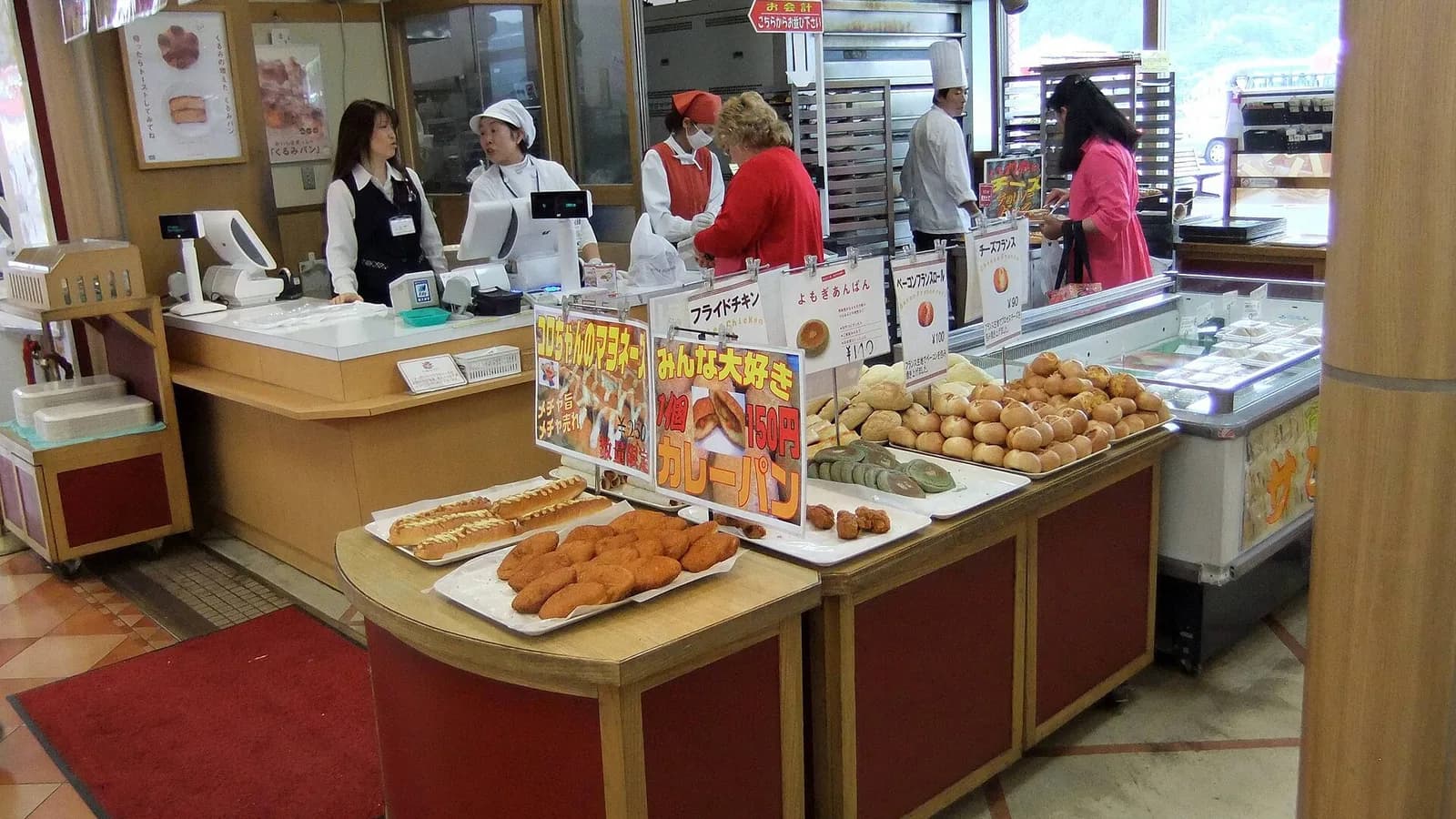
Japan's bakeries are one of the quiet pleasures of a trip. Every station and shopping street has one, the department-store basements have dozens, and the bread is its own thing: soft and slightly sweet, often filled, sometimes fried, and invented in Japan as often as borrowed from Europe.
This guide covers what to buy, how to buy it (with a tray and a pair of tongs), the old bakeries worth a detour, and how bread fits around a ryokan stay. The history and details come from each bakery's own site and were checked in October 2026.
The tray and tongs
Walk into almost any Japanese bakery and you'll find a stack of trays and a pot of tongs by the door. That's the system:
- Take a tray and tongs. The tray is often lined with a sheet of paper.
- Pick your bread with the tongs, never your fingers. Each item has a label with its name and price. Many shops also show "new" or "fresh out of the oven" tags and the time the next batch is due.
- Take the tray to the till. Staff total it, wrap or bag each piece, often separately, and ask whether you'd like a bag, which costs extra (say "fukuro onegaishimasu" if you want one).
- Pay. Many bakeries take cards and IC cards like Suica, but small independent ones may be cash only.
It feels timeless, but it isn't that old. Hiroshima Andersen, which opened on Hiroshima's Hondori shopping street in 1967, says it was the first bakery in Japan to introduce self-service bread.
A few items, usually sandwiches, cream-filled pastries or whole loaves of shokupan, sit behind the counter or in a chilled case. Ask for those by pointing.
What to buy
Anpan
Anpan (あんパン) is a soft roll filled with sweet red bean paste (anko), and it's where the Japanese bakery began. Kimuraya (木村屋總本店), founded in 1869, says its founder Kimura Yasubei and his son Eizaburo created sakadane anpan in 1874 in Ginza. The bread at the time was hard and sour and few Japanese people liked it, so they raised the dough with sakadane, a starter of rice, koji and water that is also used for sake buns, and filled it with bean paste.
On 4 April 1875 they presented a version to the Emperor Meiji, who was viewing cherry blossom at the Mito domain residence in Mukojima, with a salted double cherry blossom from Yoshino pressed into the top. The Emperor and Empress liked it, Kimuraya became a supplier to the court, and 4 April is now registered as Anpan Day. The cherry-blossom anpan (酒種あんぱん 桜) is still on sale. Kimuraya's third-generation owner went on to invent jam pan in 1900. Kimuraya has shops in many Tokyo department stores and stations, including Ginza Mitsukoshi, Nihombashi Mitsukoshi, Shinjuku Isetan and Tokyo Daimaru, and the original shop in Ginza 4-chome still bakes and sells bread.
Melonpan
 A chocolate-chip melonpan. Photo: Douglas Paul Perkins, CC BY 3.0, via Wikimedia Commons (resized).
Melonpan (メロンパン) is a soft sweet bun under a thin crust of biscuit dough that bakes crisp and crackled. It's named for its look, usually scored with a criss-cross pattern like a cantaloupe's skin, and most contain no melon at all. Variations include chocolate chip, matcha, and melonpan split and filled with ice cream.
Asakusa Kagetsudo (浅草花月堂) is the famous one. Its jumbo melonpan is about three times the size of a normal bun, and the shop says it sells 3,000 a day. The owner studied fermentation at the Tokyo University of Agriculture, and the dough gets a three-hour, low-temperature rise, which is why it's so light inside. The main shop is at the entrance to the Nishi-sando shopping street, beside Senso-ji's main hall, and opens at 11:00 on weekdays and 10:00 at weekends and holidays until the melonpan sell out. It costs 320 yen. There's a second shop on Raimon Yanagi-koji, just inside the Kaminarimon gate.
Kare pan (curry bread)
 Curry bread, bitten. Photo: ayustety, CC BY-SA 2.0, via Wikimedia Commons (resized).
Kare pan (カレーパン) is dough wrapped round thick Japanese curry, coated in panko breadcrumbs and deep-fried, though some bakeries bake theirs. It's best within an hour of frying.
Who invented it is disputed. The Japan Curry Pan Association says it's most often credited to Meikado, now Cattlea (カトレア), in Morishita, whose second-generation owner registered a "Western-food bread" (洋食パン) in 1927: a filled bread fried like a cutlet, although the registration doesn't mention curry. Denmark Brot in Nerima, founded in 1934, says its founder invented curry bread, starting with a curry sandwich. Both are still baking.
Cattlea is beside exit A7 of Morishita Station on the Toei Shinjuku and Oedo lines. It opens Tuesday to Saturday, and fresh curry bread comes out at about 7:00, 11:00 and 15:00 (15:30 on Fridays and Saturdays). Check the times on its board before you queue. It's cash only.
Shokupan
Shokupan (食パン) is Japanese white sandwich bread: tall, soft, fine-crumbed and slightly sweet, sold as a loaf and sliced thick, often 4, 5, 6 or 8 slices to the loaf (the number is on the bag). Toasted thick with butter, it's the base of the kissaten morning set (see our coffee guide).
Shinshindo (進々堂) in Kyoto, founded in 1913, says it sold Japan's first sliced, wrapped shokupan, its "Daily Bread", in 1952. Its founder, Tsuzuki Hitoshi, is known as the first Japanese baker to go to Paris to study bread, in 1924, and Shinshindo is still known for French bread. There are Shinshindo shops in central Kyoto and two by Kyoto Station: one in front of JR Kyoto Station and one in JR Kyoto Isetan.
Sando
Sando is Japanese for sandwich, and shokupan is the bread for it, with the crusts cut off.
- Tamago sando: egg salad, soft and creamy. Every konbini sells one, and our konbini guide has more on that.
- Katsu sando: a breaded pork cutlet with sweet tonkatsu sauce.
- Fruit sando: strawberries, kiwi or mango in whipped cream, cut so the fruit makes a pattern. You'll find them at fruit parlours and department-store bakeries.
And the rest
Look for cream pan (custard-filled), chocolate cornets, yakisoba pan (fried noodles in a hot-dog roll), mentaiko France (baguette with spicy cod roe butter) and shio pan, a buttery salted roll that's had a long boom.
Ryokans Near the Bakeries
One inn near each of the bakery cities in this guide: Tokyo, Kyoto, Kobe and Hiroshima.


Bakeries worth a detour
Tokyo
- Kimuraya, Ginza and department stores: the original anpan (see above).
- Asakusa Kagetsudo, Asakusa: jumbo melonpan.
- Cattlea, Morishita: the curry bread that may have been the first.
Yokohama: Pompadour
Pompadour (ポンパドウル) opened its first bakery in Motomachi, Yokohama, on 29 November 1969, as a "luxurious and elegant European-style bakery" for a shopping street then known for Western fashion. Two bakers, one in French bread and one in Danish pastry, were brought from Europe to teach the staff. Every Pompadour shop still bakes in its own kitchen from flour, without frozen dough. The cheese batard, a cheese-filled French loaf launched on opening day, is still the classic order. Look for the red bag.
Kyoto: Shinshindo
Shinshindo, founded in 1913, is the Kyoto bakery (see shokupan above). Its Kitayama and Sanjo Kawaramachi branches have cafes.
Kobe: Freundlieb
Freundlieb (フロインドリーブ) was opened in 1924 in Nakayamate by Heinrich Freundlieb, a former German navy baker who had stayed on in Japan after being held as a prisoner of war, and his Japanese wife, Yon. Their story became an NHK morning drama. It reached its hundredth year in 2024 and now has its shop and cafe in a renovated church in Ikuta-cho, with bread and biscuits baked in the workshop next door. From 1 October to 30 December 2026 the shop closes at 17:30.
Hiroshima: Andersen
The Andersen Group was founded in Hiroshima in 1948 by Takaki Shunsuke, his wife Akiko and two employees. After a trip to Denmark in 1959 it began selling Danish pastries in 1962. Hiroshima Andersen, the flagship on Hondori, opened in 1967 in a 1925 building that had survived the atomic bomb. It closed for rebuilding in 2016 and reopened on the same site in August 2020. The ground-floor bakery market opens 10:00 to 19:30, and the sandwich stand from 7:30. The group's other bakeries include Little Mermaid, a neighbourhood chain it started in 1972, and Andersen shops in department stores across Japan.
Department-store bakeries
The food floors in the basement of a department store, the depachika, are the easiest place to try several bakeries in one go: Kimuraya, Andersen and Shinshindo all have counters in department stores, alongside French bakeries and the store's own. Prices are a little higher than on the street, but everything is fresh, and the staff wrap it for travel.
Big stations work the same way, with bakeries in their food halls. Buy bread there for the train, and see our ekiben and station guide for the other things to eat on board.
Seasonal bread
Bakeries change their shelves with the season, and the specials are often the best things in the shop.
- Spring: cherry blossom. Kimuraya's salted-cherry anpan is the classic, and sakura bean paste turns up in buns and danishes everywhere in March and April.
- Summer: citrus, yuzu and ice-cream melonpan.
- Autumn: chestnut, sweet potato and pumpkin, which is when this guide was written. Halloween buns appear in October, often shaped like pumpkins or cats.
- Winter: stollen and Christmas cakes, then New Year breads. Many bakeries close for a few days over the New Year, so check before you go.
Bread around a ryokan stay
- Room-only plan? Buy breakfast the night before. Bread keeps overnight, and rural bakeries can be closed in the morning. An anpan and a carton of milk are a classic Japanese breakfast, if not the healthiest one.
- Keep it in your room. Don't bring bread into the dining room, and follow the inn's rules on food in rooms.
- Don't spoil dinner. A kaiseki dinner is ten or more courses, usually from 18:00. Our ryokan dinner guide explains what's coming. One melonpan at 14:00 is fine. Three isn't.
- Compare with breakfast. A ryokan breakfast is usually rice, fish and miso, and bread is rarely on the table. Our ryokan breakfast guide explains it, and the morning after a ryokan is a good time for a bakery.
- Plan your route. Our Japan ryokan itinerary passes through Tokyo, Kyoto and Hiroshima, and our Japan Rail Pass guide covers getting between them.
Ryokans near the bakeries
- Ryokan Asakusa Shigetsu is an 80-year-old inn three minutes from Senso-ji, with a sixth-floor cypress bath looking at the pagoda and the Skytree. Asakusa Kagetsudo is on the other side of the temple grounds.
- Hoshinoya Tokyo is a 17-storey ryokan in Otemachi, close to the department stores of Nihonbashi and Ginza where Kimuraya has its counters.
- Matsubaya Ryokan was founded in 1884 at the gate of Higashi Honganji and rebuilt in 2008. It's ten minutes on foot from Kyoto Station and Shinshindo's station branch.
- Arima Onsen Nakanobo Zuien has received guests in Arima Onsen, in the hills above Kobe, since 1868. Pick up bread in the city on the way.
- Itsukushima Iroha is on Miyajima, a train and a ferry from Hiroshima, so Hiroshima Andersen on Hondori fits on the way there or back.
Sources
Checked October 2026.
- Kimuraya Sohonten: history (1869, 1874, 1875, jam pan in 1900); sakadane anpan; the 1875 presentation; Anpan Day; company information (department-store shops, Ginza Kimuraya; all Japanese).
- Asakusa Kagetsudo: official site (3,000 a day, fermentation, shops); main store hours; menu (all Japanese).
- Japan Curry Pan Association: the origin of curry bread (Japanese).
- Tabelog: Cattlea (address, days, frying times, payment; Japanese).
- Shinshindo: company information (1913, Paris); history (Daily Bread, 1952); shops (all Japanese).
- Pompadour: company information (29 November 1969, one shop one kitchen; Japanese); About Pompadour (European bakers, no frozen dough); 50 years (cheese batard; Japanese).
- Freundlieb: history (1924, Heinrich and Yon Freundlieb, NHK drama); official site (church building, autumn 2026 hours; Japanese).
- GINZA OFFICIAL: Ginza Kimuraya (the Ginza shop still bakes).
- Andersen Group: history (1948, Danish pastry, first self-service bread, Little Mermaid in 1972; Japanese); Hiroshima Andersen history (Japanese); the 1925 building (Japanese); Hiroshima Andersen hours (Japanese).
Photo credits
- Cover: "パン店" (a Japanese bakery) by Gwydion M. Williams, CC BY 2.0, via Wikimedia Commons. Cropped and resized.
- Melonpan by Douglas Paul Perkins, CC BY 3.0, via Wikimedia Commons. Resized.
- Curry bread by ayustety, CC BY-SA 2.0, via Wikimedia Commons. Resized.


Free ryokan planning guide
Japan travel tips, etiquette essentials, and our top picks — straight to your inbox.
Explore Top Ryokans
Discover highly rated traditional Japanese inns
Ready to book your ryokan?
Check dates, rooms and current rates for ryokans across Japan.
Planning a ryokan stay?
Get our free Japan ryokan planning guide — packing tips, etiquette, and our top picks by region.
No spam. Unsubscribe anytime.
Related guides
- Matcha in Japan: where to drink it and what to bring homeWhere to drink matcha in Uji, Kyoto, Tokyo and Kanazawa, from the old Uji tea houses to a municipal tea room facing the Byodo-in. Usucha and koicha explained, what to do at a tea ceremony, the sweets that come with it, and how to buy and keep tea to take home.
- Ekiben and Japan's big stations: what to eat on the train and how to find your wayThe station bento worth seeking out, from Mori's squid stuffed with rice to the Toge no Kamameshi pot and Toyama's trout sushi, where to buy them at Tokyo, Shinjuku, Sendai and Toyama, train-eating etiquette, and how to survive the big stations: food halls, coin lockers, IC cards, exits and signs.
- Coffee in Japan: kissaten, roasters, cans and the morning setHow Japan drinks coffee, from the old kissaten of Ginza and Kyoto to Tokyo's light-roast specialty bars, the canned coffee in every vending machine, the konbini cup and the morning set that comes with free toast. Where to go, what to order and how it fits around a ryokan stay.
Ryokan Finder Editorial
We research and organize traditional Japanese inns across the country. About Ryokan Finder