Japan drinks a lot of coffee, and in more ways than almost anywhere. There are hushed old coffee houses where a master hand-pours one cup at a time, light-roast bars that would fit in Melbourne or Oslo, vending machines that sell coffee hot in winter, and convenience-store machines that grind a cup to order for less than a train fare.
This guide covers all four, with a few places in Tokyo and Kyoto to start with, how the morning set works, and how coffee fits around a ryokan stay, where breakfast usually comes with green tea. Opening times and other details were checked against each business's own site in October 2026.
The kissaten
A kissaten (喫茶店, literally "tea-drinking shop") is the traditional Japanese coffee house. They spread after the war, and the best of them have barely changed: dark wood, a long counter, cups chosen for each customer, a blend roasted in house, and a short menu of toast, sandwiches, pudding and cake. Coffee is often brewed by hand through a paper filter, a flannel cloth (nel drip) or a siphon, which takes a few minutes. That's part of the point.
Ordering is simple. Burendo (ブレンド) is the house blend, served hot unless you say aisu (iced). Single-origin coffees are listed by country. Many kissaten bring milk and sugar automatically, and some recommend you use them.
Ordering in a kissaten
A few words cover most menus:
- Hotto (ホット), hot coffee, and aisu kōhī (アイスコーヒー), iced. In many kissaten "hotto" on its own means the house blend.
- Kafe ore (カフェオレ), coffee with hot milk, and wiinā kōhī (ウインナーコーヒー), coffee topped with whipped cream.
- Kōhī zerī (コーヒーゼリー), coffee jelly, usually with cream: the classic kissaten dessert.
- Setto (セット), a set, usually a drink with toast, a sandwich or cake at a small discount.
The routine is the same almost everywhere. Wait to be seated, or take a free table if the staff wave you in. You'll be brought water and often a hot or cold towel (oshibori). Order when you're ready, and the bill comes to the table on a slip, which you take to the till by the door when you leave. Tipping isn't expected. Lingering is fine, as long as you've ordered, but give up the table at busy times, and keep phone calls outside.
 Inoda Coffee's main shop on Sakaimachi-dori, Kyoto. Photo: KCyamazaki, CC BY-SA 4.0, via Wikimedia Commons (cropped and resized).
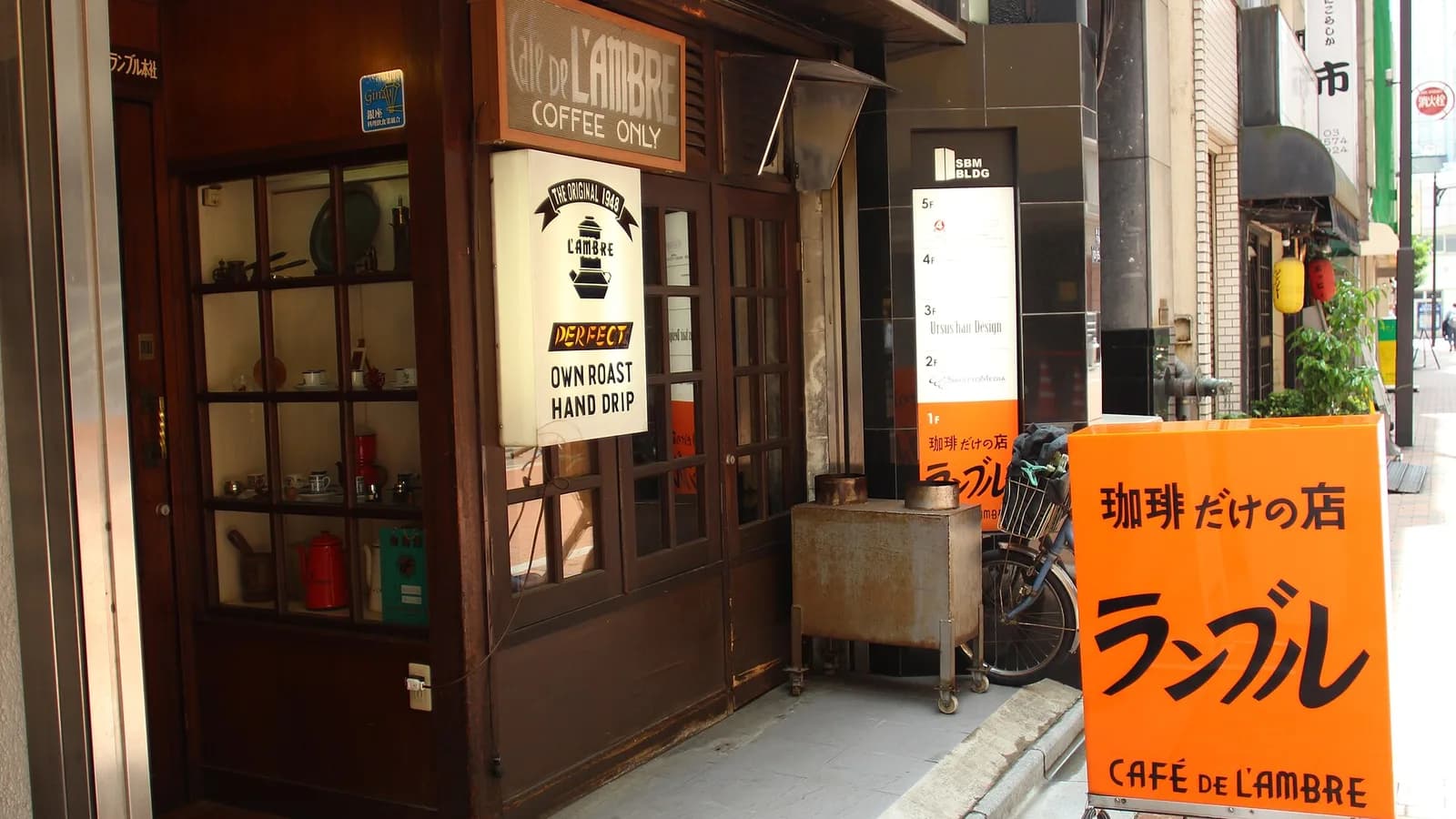
Café de l'Ambre, Ginza
Café de l'Ambre (カフェ・ド・ランブル) has served coffee and nothing else since 1948. Its founder, Ichiro Sekiguchi, roasted his own beans and built the shop's style around hand-sewn flannel filters, aiming for a clear, amber cup. The name means "amber". The menu has a house blend and a long list of single-origin coffees, including "old coffee" made from beans aged for years before roasting. Tell the staff whether you prefer bitter or acidic, and they'll suggest something.
It's on a backstreet at 8-10-15 Ginza, between Ginza and Shimbashi stations. It opens 11:00 to 20:00 on weekdays (last orders 19:00) and 11:00 to 18:00 on Sundays and holidays (last orders 17:00), and closes on Mondays. Prices went up by 100 yen across the menu on 1 May 2026.
Inoda Coffee, Kyoto
"Kyoto mornings start with Inoda," the saying goes. Inoda Coffee began in 1940, when Shichiro Inoda started selling imported coffee beans from the building that is still its main shop, and opened its first coffee shop there in 1947. The main shop (本店) on Sakaimachi-dori, south of Sanjo, is a machiya-style building with 211 seats and a garden terrace, five minutes from Karasuma-Oike subway station. It opens 7:00 to 18:00 every day, and you can't book a table.
Come before 11:00 for the Kyoto breakfast (京の朝食), Inoda's best-known order, at 1,890 yen: ham, scrambled egg and salad on one plate, a croissant, and Arabia no Shinju (Pearl of Arabia), the house blend it has served since it opened. Kyoto's tourism association notes that the blend is meant to be drunk with milk and sugar, and that's how it's served unless you say otherwise. Inoda has other branches in Kyoto, including two inside Kyoto Station.
Smart Coffee, Kyoto
Smart Coffee (スマート珈琲店) opened on Teramachi, just north of Sanjo, in 1932 as Smart Lunch and has roasted its own beans since. It's one minute from Kyoto Shiyakusho-mae subway station, open 8:00 to 19:00, and known for its hotcakes and French toast. Upstairs, a Western-style lunch room serves 11:00 to 14:30 (last orders) and is closed on Tuesdays. The whole shop has been non-smoking since April 2020.
The morning set
In much of Japan, but nowhere more than Nagoya, a cafe breakfast comes as a morning set (モーニング, "moningu"). You pay for the drink and get food with it, usually thick toast and an egg, until a cut-off time. It's how a lot of Japanese office workers eat breakfast, and it's the cheapest sit-down breakfast you'll find.
Komeda's Coffee, the chain most associated with it, explains its version plainly: from opening until 11:00 every day, order any drink and choose a free slice of toast or a bread roll, with one of a boiled egg, egg paste or Komeda's own sweet red bean paste (ogura-an). There are branches across the country, including in station areas and suburbs where an independent kissaten would be hard to find.
Kissaten morning sets vary: some charge a little extra for the food, some include salad or yogurt, and most finish at 10:00 or 11:00. Look for モーニング on a board outside.
Ryokans Near the Coffee Shops
Two Kyoto inns near the old kissaten and three in Tokyo, from Asakusa to Hongo, across the price range.


Specialty coffee
Since the 2010s Tokyo and Kyoto have filled up with specialty roasters, mostly roasting light and serving single origins as pour-overs. It's a long way from the dark kissaten blend, and many of the best are run by baristas who trained abroad.
Tokyo
- Fuglen Tokyo, Tomigaya. Fuglen opened its first branch outside Oslo here in 2012: light "Nordic roast" coffee and Norwegian vintage design by day, cocktails at night. It opens at 7:00, and stays open late as a bar. A second branch in Asakusa, by the west side of Senso-ji, opened in 2018 and serves coffee and Norwegian waffles from 8:00.
- Glitch Coffee & Roasters, Jimbocho. Opened in 2015 in the old bookshop district, Glitch roasts light and serves single origins. It opens 8:00 to 19:00 on weekdays and 9:00 to 19:00 at weekends. There's a second shop, Glitch Tokyo, in Nihonbashi.
- Onibus Coffee, Nakameguro. The Nakameguro Ekimae shop is one minute from Nakameguro Station, open 9:00 to 18:00 with occasional closing days. Onibus also has shops in Okusawa, Yakumo, Jiyugaoka and Shibuya.
- Koffee Mameya Kakeru, Kiyosumi-Shirakawa. A coffee tasting course, served omakase-style at a counter in a converted warehouse: the same beans brewed several ways, with food pairings. Reservations are required.
Kyoto
- Weekenders Coffee began as a cafe in 2005 and has roasted its own beans since 2011. Its much-loved stand in a car park off Tominokoji closed on 15 April 2026. The new Weekenders Coffee Shinmachi opened on 30 September 2026 in Ubayanagi-cho, Nakagyo-ku, near Shijo-Karasuma. Check its Instagram for hours while it settles in.
- Kurasu Kyoto Stand, five minutes from Kyoto Station, opened in 2016 and serves specialty coffee roasted at its own Nishijin roastery. It's a good first or last cup of a Kyoto stay. It opens 8:00 to 18:00, with closing days announced on social media.
Coffee in a can
The canned-coffee aisle is a Japanese invention. UCC sold the world's first canned coffee in April 1969, a milk coffee, after its founder had to leave a bottle unfinished when his train pulled out of a station. Sales took off at the Osaka Expo in 1970. Coca-Cola Japan launched Georgia in 1975 and Suntory followed with BOSS in 1992. They're still the three names you'll see most.
Vending machines sell coffee hot as well as cold, and in autumn and winter many switch half their rows to hot. Hot drinks are usually marked in red and cold in blue. The cans are hot, so hold one by the top. Bottles with screw caps sit beside them now, and the range runs from unsweetened black (ブラック, often labelled 無糖, no sugar) through "bitter" and "rich" to very sweet milk coffee and cafe au lait. If you don't take sugar, look for 無糖.
Konbini coffee
Convenience-store coffee is fresh-ground, cheap and surprisingly good. At 7-Eleven and FamilyMart you buy the cup at the till, then make the drink yourself at the machine. Lawson's MACHI café is made in store. Our konbini guide explains how each one works and what else to buy.
For an early train, a konbini coffee and an egg sandwich from the station is the quickest breakfast there is.
Coffee around a ryokan stay
A ryokan breakfast is normally Japanese: rice, grilled fish, miso soup, pickles and green tea, served at a set time in your room or the dining room. Our ryokan breakfast guide explains it. Many inns do offer coffee, but not always the moment you wake up.
- Ask when you book. Many ryokan serve coffee after breakfast or in a lounge, and some put a drip coffee kit or capsule machine in the room. Ask at check-in.
- Buy the night before. In an onsen town there may be nothing open early. A can from the vending machine, or a bottle from the konbini, will keep in the room fridge.
- Save the morning set for the day after. On the morning you leave a ryokan you'll already have eaten a big breakfast. The day after, a kissaten morning set in the city is a good way to ease back in.
- Don't arrive full. Kaiseki dinner starts early, often at 18:00, and runs to ten or more courses. Our ryokan dinner guide explains the timing. A cake with your afternoon coffee is fine, but a second lunch isn't.
- Planning the route? Our Japan ryokan itinerary links Tokyo and Kyoto with ryokan nights in between, and the Japan Rail Pass guide covers the trains. Our shinkansen guide has the practical side of the train itself.
If you'd rather have green tea, our matcha guide covers the tea houses of Uji, Kyoto, Tokyo and Kanazawa, and our bakery guide covers the bread to go with the coffee.
Ryokans near the coffee shops
- Nishiyama Ryokan is a 1953 inn in central Kyoto, two minutes from Kyoto Shiyakusho-mae Station, with separate men's and women's baths, a garden and a Japanese breakfast. Smart Coffee is round the corner, and Inoda's main shop is a short walk.
- Ryokan Motonago has 11 rooms in a machiya of about 1905 on Nene-no-michi below Kodai-ji, with kaiseki served in the room and yudofu for breakfast.
- Ryokan Asakusa Shigetsu is an 80-year-old inn three minutes from Senso-ji, with a sixth-floor cypress bath looking at the pagoda and the Skytree, and a short walk from Fuglen Asakusa.
- Homeikan is a century-old ryokan in Hongo whose main building was the first lodging in Tokyo listed as a cultural property. Jimbocho's coffee shops and bookshops are a short ride away.
- Andon Ryokan is a designer ryokan in Minowa, opened in 2003, with tatami rooms, shared baths and an Arita-porcelain jacuzzi you book by the half hour. It's the budget pick.
Sources
Checked October 2026.
- Café de l'Ambre: official site (history, flannel drip, hours, closing day; Japanese); store menu and history (Japanese); price change, 1 May 2026 (Japanese).
- Inoda Coffee: main shop (hours, seats, smoking, access; Japanese); main shop menu (Kyoto breakfast; Japanese); history; shops (Japanese); Kyoto Prefecture Tourism Federation, Inoda Coffee Honten (blend with milk and sugar; Japanese).
- Smart Coffee: about (1932, Smart Lunch); shop information (hours, lunch, access); no-smoking notice (all Japanese).
- Komeda's Coffee: morning service (Japanese).
- Fuglen: Fuglen Tokyo; Fuglen Asakusa; Fuglen Tokyo Tomigaya.
- Glitch Coffee & Roasters: official site; Jimbocho store hours.
- Onibus Coffee: Nakameguro Ekimae (Japanese); shops.
- Koffee Mameya: official site; Sprudge, coffee omakase in Tokyo (Kakeru, reservations).
- Weekenders Coffee: official site (Shinmachi opening, 30 September 2026); news (Tominokoji closing, 15 April 2026; Japanese).
- Kurasu: Kurasu Kyoto Stand.
- UCC Ueshima Coffee: company history (world's first canned coffee, 1969); UCC Milk Coffee (the station story and the Osaka Expo; Japanese).
- The Coca-Cola Company: Georgia Coffee (since 1975).
- Suntory: BOSS (since 1992).
Photo credits
- Cover: "珈琲だけの店 ランブル" (Café de l'Ambre, Ginza) by Bex Walton, CC BY 2.0, via Wikimedia Commons. Cropped and resized.
- Inoda Coffee main shop by KCyamazaki, CC BY-SA 4.0, via Wikimedia Commons. Cropped and resized.


Free ryokan planning guide
Japan travel tips, etiquette essentials, and our top picks — straight to your inbox.
Explore Top Ryokans
Discover highly rated traditional Japanese inns
Ready to book your ryokan?
Check dates, rooms and current rates for ryokans across Japan.
Planning a ryokan stay?
Get our free Japan ryokan planning guide — packing tips, etiquette, and our top picks by region.
No spam. Unsubscribe anytime.
Related guides
- Matcha in Japan: where to drink it and what to bring homeWhere to drink matcha in Uji, Kyoto, Tokyo and Kanazawa, from the old Uji tea houses to a municipal tea room facing the Byodo-in. Usucha and koicha explained, what to do at a tea ceremony, the sweets that come with it, and how to buy and keep tea to take home.
- Japanese bakeries: melonpan, curry bread and the tray-and-tongs ritualWhat to buy in a Japanese bakery, from anpan and melonpan to curry bread, shokupan and sando, how the tray-and-tongs system works, the old bakeries worth a detour in Tokyo, Yokohama, Kyoto, Kobe and Hiroshima, depachika bread counters and the seasonal specials.
- Ekiben and Japan's big stations: what to eat on the train and how to find your wayThe station bento worth seeking out, from Mori's squid stuffed with rice to the Toge no Kamameshi pot and Toyama's trout sushi, where to buy them at Tokyo, Shinjuku, Sendai and Toyama, train-eating etiquette, and how to survive the big stations: food halls, coin lockers, IC cards, exits and signs.
Ryokan Finder Editorial
We research and organize traditional Japanese inns across the country. About Ryokan Finder